

Can EMDR Treat Complex Trauma and CPTSD?
When It Works and How It’s Adapted
Alex Penrod, MS, LPC, LCDC — Founder & EMDR Therapist | Neuro Nuance Therapy and EMDR, PLLC
Can EMDR Treat Complex Trauma and CPTSD?
- Yes. EMDR can effectively treat complex trauma and Complex Post-Traumatic Stress Disorder (CPTSD).
- Research shows trauma-focused treatment, including EMDR, can significantly reduce complex PTSD symptoms.
- Formal stabilization phases are not always required, but intentional preparation and pacing improve safety and outcomes.
- EMDR is adapted for developmental trauma through careful target sequencing and regulation support.
- The goal is to help traumatic memories lose their emotional charge and expand safety and confidence beyond protective patterns.
Yes, Eye Movement Desensitization and Reprocessing (EMDR) can be an effective treatment for complex trauma and Complex Post-Traumatic Stress Disorder. But it is not applied in the same way it is for a single traumatic event.
When people ask whether EMDR works for complex trauma, they are usually asking whether it can help with patterns that developed over years of overwhelming or repeated traumatic experiences. Treating complex PTSD often involves working with attachment disruption, chronic stress activation, difficulty regulating emotions, protective survival responses such as numbing or dissociation, and deeply rooted negative beliefs about identity and safety. That is very different from targeting one isolated incident.
As an EMDR therapist in Austin, I work with people with developmental trauma and attachment injuries regularly. For these individuals, EMDR is not rushed. The process is adjusted to match the nervous system’s capacity. Preparation becomes more intentional. Target selection becomes more strategic. The pacing is slower and more collaborative.
When this is done well, EMDR treatment can reduce reactivity, soften long-held shame-based beliefs, and support lasting integration within the broader process of trauma therapy. When it is rushed or applied without sufficient stabilization, it can increase overwhelm or reinforce protective shutdown patterns.
The question is not simply whether EMDR works. The more important question is whether it is being used in a way that fits complex trauma and the individualized treatment of Complex PTSD.
Why Complex Trauma Changes the Way EMDR Is Applied
Single-incident PTSD often centers around one or a few identifiable events. There is usually a clear “before” and “after.” The person may have had a relatively stable sense of self and relationships prior to the trauma, even if the event was severe. This type of single-event trauma is often linked to one specific memory network.
Complex trauma and CPTSD are different. They often involve:
Repeated or prolonged exposure to interpersonal trauma, such as childhood abuse, sexual abuse, or domestic violence
Chronic emotional neglect or emotional abuse during critical developmental periods
Trauma occurring during childhood or adolescence while identity was still forming
Attachment disruption rather than a single event
Chronic activation of survival responses over time
A lack of a clear “before trauma” baseline
Instead of one event, there may have been hundreds or thousands of moments across formative life experiences that communicated danger, instability, or emotional absence.
In these cases, the trauma is not only stored as isolated memories. It can shape core expectations about self and others, attachment patterns, and baseline levels of physiological activation. These patterns often show up as ongoing complex PTSD symptoms, including emotional dysregulation, relational instability, and persistent shame.
This difference changes how EMDR is applied. With single-incident PTSD, preparation may be brief and reprocessing can often move more directly toward the central traumatic memory.
With complex trauma and CPTSD, reprocessing is usually approached more gradually. Early work often focuses on strengthening present-day capacity, building internal stability, and carefully sequencing targets rather than immediately targeting early developmental material.
The goal is not just to desensitize a memory. It is to increase overall stability and integration across multiple interconnected memory networks.
When EMDR Tends to Work Well for Complex Trauma and CPTSD
EMDR tends to work well for complex trauma when there is enough internal stability and resourcing to tolerate exposure to difficult memories, enough access to adaptive information processing to support integration, and the ability to stay oriented to the present.
That does not mean someone must feel calm or symptom-free. It means they can experience activation without immediately becoming flooded, shutting down, or disconnecting from the session.
For complex trauma survivors, readiness is not about perfect stability. It is about building capacity. EMDR is often effective when:
There is an ability to use grounding techniques, healthy coping mechanisms, and access support systems between therapy sessions
Activation and emotional distress rises but can be contained rather than feeling chaotic or out of control
There is capacity to observe internal experience with some degree of compassion rather than immediately reinforcing shame or guilt
Dissociative responses are recognized early rather than happening outside awareness
Protective reactions can be acknowledged and collaboratively addressed instead of overpowering the process
The therapeutic relationship feels steady and consistent
When these elements are in place, EMDR can help effectively process trauma so that previously distressing memories no longer carry the same emotional charge, supporting long-term trauma recovery rather than simply building coping skills or reducing surface symptoms.
Clients often notice that triggers feel less consuming in daily life, shame softens, and relational reactions become more flexible. Instead of reacting automatically from old survival templates, they begin responding from a more integrated present-day perspective.
How EMDR Is Adapted for Developmental and Attachment Trauma
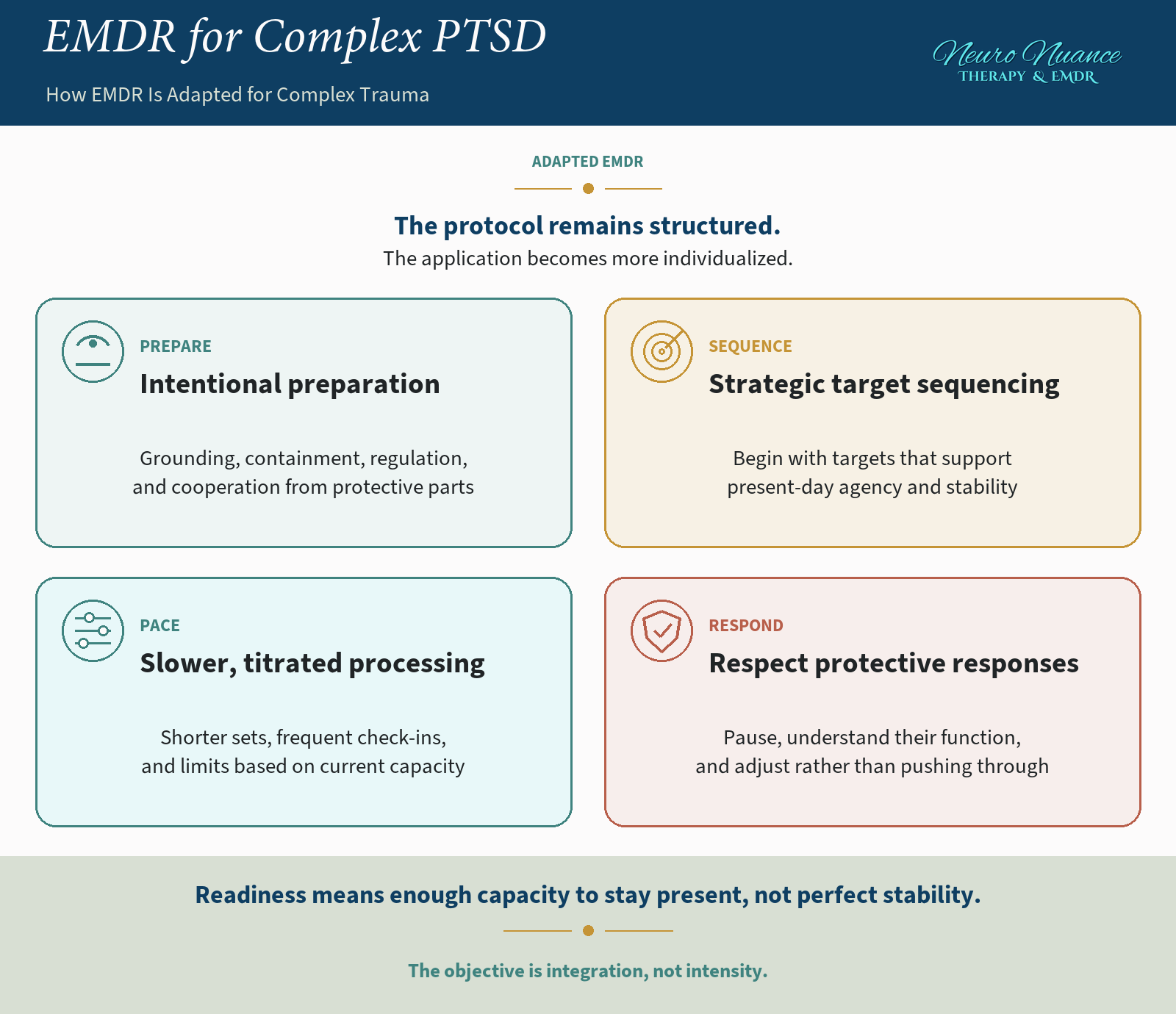
Adapted EMDR for complex trauma does not abandon the standard protocol, but it applies it with greater care, flexibility, and collaboration within the overall EMDR process.
Several aspects of the process are typically adjusted as part of a thoughtful treatment approach for complex cases.
A More Intentional Preparation Phase
With single-incident trauma, preparation may focus primarily on explaining the process and developing a few stabilization tools.
With complex trauma, preparation often becomes a central part of treatment planning.
This may include:
Strengthening safe place, grounding, and containment skills
Developing reliable internal or external sources of support
Increasing tolerance for emotion and reducing fear of emotional experience
Practicing staying oriented to the present during activation and regulating before over-activation occurs
Clarifying how dissociation shows up and how to respond to it
Gaining cooperation from protective parts that might otherwise shut down or avoid processing
This stage may also involve careful history-taking to understand patterns across traumatic memories rather than focusing only on one specific memory.
Preparation is not simply a prerequisite. It continues alongside reprocessing.
The goal is to expand the nervous system’s capacity so that integration can occur safely and a stronger sense of safety can develop over time.
Careful and Strategic Target Sequencing
In single-event PTSD, it is often appropriate to identify the central traumatic memory and move toward it directly.
With developmental or childhood trauma, memory networks are layered and interconnected. There may not be one single “root” event, and activating too much material at once can exceed available resources.
Instead of beginning with the earliest or most intense childhood memory, it can be more effective to start with current triggers, recent relational conflicts, or adult experiences that reinforce agency or safety.
This builds confidence in the process and strengthens stability before approaching earlier developmental material.
Slower, Titrated Processing
A chronically sensitized nervous system can move quickly into overwhelm or shutdown.
Adapted EMDR may involve:
Using imagery to contain, distance, or observe traumatic memories rather than being fully immersed in them
Shorter sets of bilateral stimulation
More frequent check-ins
Slower pacing
Active monitoring of activation levels
Limiting exposure to what can be successfully tolerated in a given session
If activation rises too quickly or dissociation begins to increase, the work slows down.
The objective is integration, not intensity.
Working With Protective Reactions Rather Than Pushing Through Them
In complex trauma, protective responses such as avoidance, numbing, intellectualizing, or internal conflict are common.
These responses are not obstacles to eliminate. They are signals that the system is trying to stay safe.
Adapted EMDR involves pausing to understand these reactions, acknowledging their protective function, and adjusting the pace accordingly within the broader treatment plan.
When protective responses feel understood and respected, the system is more likely to cooperate with deeper reprocessing.
What Research Shows About EMDR and Complex PTSD
EMDR is one of the most extensively studied trauma-focused treatment methods for post-traumatic stress disorder. Multiple systematic review articles have examined the efficacy of EMDR for trauma-related conditions, and it is widely recognized as an evidence-based treatment approach.
More recently, researchers have examined whether EMDR is effective in the treatment of Complex PTSD as defined by ICD-11. In one intensive residential study, 66% of participants met criteria for complex PTSD prior to treatment. After eight days of trauma-focused therapy that included EMDR, 88% no longer met diagnostic criteria. The program included multiple components and did not include a control condition, which limits generalization, but the findings were encouraging.
A later randomized controlled trial compared standard EMDR to EMDR preceded by a structured stabilization program in adults with early developmental trauma and symptoms consistent with complex PTSD. Of those who met criteria at baseline, only 3% continued to meet criteria following treatment. Outcomes did not differ between EMDR delivered alone and EMDR preceded by skills-based stabilization.
These findings suggest that EMDR can be effective in the treatment of Complex PTSD and that a mandatory phase-based stabilization protocol may not be required for everyone.
At the same time, research studies are conducted under controlled conditions. In clinical practice, individuals vary widely in dissociation, attachment patterns, and nervous system regulation. In my experience, thoughtful preparation and pacing often make trauma processing smoother, safer, and more sustainable, even when a formal stabilization block is not strictly required.
Rather than applying a rigid formula, effective treatment planning involves ongoing assessment and adjustment to match the individual’s capacity and goals.
When EMDR May Not Be the First Step
Although EMDR can be highly effective for complex trauma and CPTSD, there are situations where it may not be the immediate starting point as a treatment method.
For example, EMDR may need to be delayed or modified when:
A person is currently in an unsafe or unstable environment
There is active self-harm behavior or significant suicidal risk
Substance use is unstable and interfering with regulation
Dissociation is so severe that present-moment awareness cannot be maintained
Emotional regulation capacity is extremely limited
Co-occurring mental health issues, such as severe depression or an active eating disorder, are destabilizing the system
In these cases, the priority is stabilization and safety.
Responsible trauma treatment is not about moving quickly within a fixed time frame. It is about moving safely.
If you are unsure whether EMDR is appropriate in your current situation, you may find it helpful to read more about who should not do EMDR therapy and when additional stabilization may be necessary.
What This Means If You’re Considering EMDR for CPTSD
If you are living with complex trauma or CPTSD, it is reasonable to wonder whether EMDR is appropriate for you.
EMDR is a structured form of psychotherapy with strong research support for PTSD and growing evidence supporting its use in complex presentations. Many individuals experience significant improvements in how trauma affects their nervous system and relationships over time.
The answer is often yes, but not in a rushed or one-size-fits-all way.
A careful EMDR approach respects your history, pacing, and readiness. The goal is not simply to revisit the past. It is to help your nervous system no longer organize your present around it.
If you would like to learn more about how EMDR therapy works in general, you can explore our EMDR Therapy page. If you are specifically seeking treatment for complex PTSD, you can review our CPTSD treatment in Austin service page to learn more about how therapy is structured. Neuro Nuance Therapy and EMDR specializes in adapting EMDR for CPTSD, providing in-person therapy in Austin and virtual EMDR sessions via telehealth across Texas.
Frequently Asked Questions About EMDR for Complex PTSD
-
When EMDR is applied without adequate preparation or pacing, trauma processing can feel overwhelming. However, when treatment is adapted for developmental trauma and carefully sequenced, EMDR is generally considered safe and effective. The key factor is readiness and clinical judgment, not the diagnosis itself.
-
Not necessarily. Research suggests that a formal, extended stabilization phase is not required for everyone with complex PTSD. That said, thoughtful preparation often improves tolerability and depth of processing. Treatment decisions are individualized rather than based on a rigid timeline.
-
There is no fixed time frame. Complex trauma often involves multiple memory networks and long-standing patterns, so treatment typically takes longer than single-incident trauma. Progress is measured not just by symptom reduction, but by improved emotional stability, a healthier sense of self-worth, and increased flexibility in relationships.
-
Dissociation is a common protective response in complex trauma. If it occurs during processing, the session slows down and the focus shifts to grounding and stabilization. Recognizing and working with dissociation is part of adapting EMDR for complex cases, not a reason to abandon treatment.
-
EMDR is one evidence-based option among several trauma-focused therapies. It differs from traditional talk therapy in that it directly targets memory networks rather than focusing primarily on cognitive restructuring. The most important factor is not which therapy is “best,” but whether the approach fits your history, nervous system, and goals.
-
EMDR therapy for complex PTSD is offered at Neuro Nuance Therapy and EMDR in Austin, TX. Treatment is adapted for developmental trauma, dissociation, and attachment-related patterns using a structured EMDR approach. To learn more, visit our Complex Trauma Therapy in Austin page.
References
de Jongh, A., de Roos, C., & El‐Leithy, S. (2024). State of the science: Eye Movement Desensitization and Reprocessing (EMDR) therapy. Journal of Traumatic Stress, 37(2), 205–216. https://doi.org/10.1002/jts.23012