

Attachment Therapy in Austin, TX
EMDR Therapy for the Healing of Attachment Injuries.
Healing Survival Patterns to Build Secure Connections
Attachment-based therapy works at the level where relationships and neurobiology meet. If you find yourself craving connection but pulling away, repeating familiar relationship patterns, or feeling unworthy of love no matter how much you try to heal, you’re not alone. These patterns often trace back to early attachment experiences that shaped how your nervous system predicts safety in relationships.
At Neuro Nuance Therapy and EMDR in Austin, TX, I use Attachment-Focused EMDR to help you gently unlearn survival responses and experience secure connection. This begins in the therapeutic relationship, then within yourself, your internal world, and outward to the people you care about. Together, we’ll rebuild the sense of safety and worth that makes true intimacy possible.

Alex Penrod, MS, LPC, LCDC
Founder and Therapist
Welcome, allow me to introduce myself. I’m a Licensed Professional Counselor (LPC), Licensed Chemical Dependency Counselor (LCDC), and a person in long-term recovery with 10 years of experience working in the behavioral health treatment field.
As a trauma therapist, I specialize in Eye Movement Desensitization and Reprocessing Therapy (EMDR) which can be adapted specifically for attachment-based issues using a version known as Attachment-Focused EMDR.
Many of my clients with childhood trauma notice volatility in their romantic relationships, but it can also show up with family members, friends, co-workers, and children. Attachment-Focused EMDR allows us to zero in on the origins of relational instability specifically, and shift the patterns, as opposed to just desensitizing traumatic events in general.
In-Person Therapy: I provide in-person EMDR therapy in North and Southwest Austin.
Telehealth: Convenient virtual EMDR sessions help adults throughout Texas heal from home.
I welcome new clients from all walks of life. To learn more about how I can help you find lasting healing, schedule your free 15-minute consultation with me. I’d love to learn more about your goals and answer any questions you may have.
What Are Attachment Injuries?
Attachment injuries typically involve early childhood disruptions in the development of a secure bond with a caregiver, but they can also include adult experiences of betrayal, abuse, or abandonment that leave lasting patterns in future relationships. These include but are not limited to:
Adoption
Divorce
Parental Alienation
Abandonment
Inconsistent Caregiving
Neglect
Parentification and Role Reversal
Abuse (verbal, emotional, physical, sexual)
Coercive Control
Attachment injuries can lead to the development of complex and developmental trauma, dissociative symptoms, and long-term relational patterns known as attachment styles. Attachment styles are distinguished as being secure vs insecure and fall along a continuum at the intersection of attachment related anxiety vs avoidance.

The Four Adult Attachment Styles
-
![Image of two people leaning on each other in secure attachment.]()
Secure Attachment
Secure attachment develops when early relationships consistently provide safety, responsiveness, and emotional attunement. Adults with this style generally feel comfortable with both closeness and independence, trusting that connection is safe and mutual. They regulate emotions effectively and seek support without fear of rejection or engulfment.
-
![Image of a person with their hands clasped touching face in anxious preoccupied anticipation.]()
Anxious-Preoccupied Attachment
Anxious-preoccupied attachment forms when caregiving is inconsistent, sometimes attentive, sometimes unavailable. Adults with this style often crave closeness and reassurance but fear abandonment or rejection. They may become hypervigilant to relational cues and struggle to feel secure without external validation.
-
![Image of a person with their hands up pushing away in dismissive avoidance.]()
Dismissive-Avoidant Attachment
Dismissive-avoidant attachment develops when emotional needs were met with rejection or indifference. Adults with this style tend to value self-reliance and minimize vulnerability, often suppressing emotions or distancing when others get close. Connection can feel intrusive, leading them to appear independent while avoiding deeper intimacy.
-
![Image of a person with hands on head appearing overwhelmed and confused with disorganized feelings.]()
Fearful-Disorganized Attachment
Fearful-disorganized attachment often arises when caregivers were both a source of comfort and fear, creating deep relational confusion. Adults with this style may long for closeness yet feel unsafe when it occurs, leading to push-pull dynamics and emotional ambivalence. They often struggle with trust and self-worth, oscillating between vulnerability and withdrawal.




Attachment Anxiety Versus Avoidance Continuum
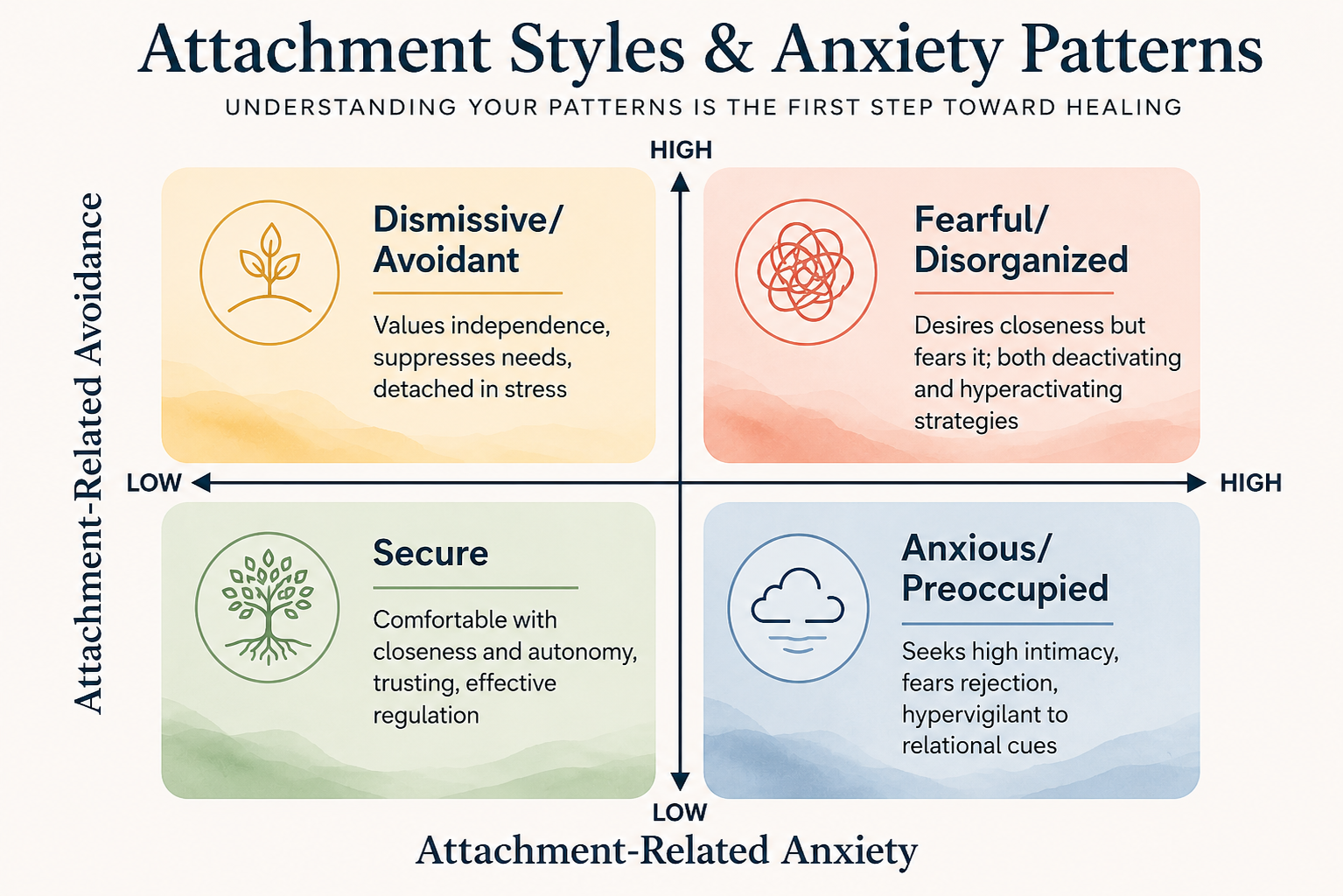
Figure 1. Adult attachment continuum showing anxiety (x-axis) and avoidance (y-axis) dimensions with four styles: Secure, Anxious/Preoccupied, Dismissive/Avoidant, and Fearful/Disorganized. Adapted from Bartholomew, K., & Horowitz, L. M. (1991). Attachment styles among young adults: A test of a four-category model. Journal of Personality and Social Psychology, 61(2), 226–244. https://doi.org/10.1037/0022-3514.61.2.226
What is Attachment-Focused EMDR?
Attachment-Focused EMDR (AF-EMDR) is an integrative adaptation of Eye Movement Desensitization and Reprocessing that centers on repairing early relational and attachment wounds underlying present-day symptoms. Developed by Laurel Parnell and others, this approach combines EMDR’s eight-phase protocol with an emphasis on safety, attunement, and the therapeutic relationship as a corrective emotional experience.
AF-EMDR prioritizes resource development, such as nurturing, protective, and wise figures, before trauma processing, allowing you to build internal security and better emotion regulation. By reprocessing attachment-related memories through a co-regulated, compassionate framework, you can transform survival-based patterns into new neural pathways of trust, self-worth, and secure connection.
Comparisons Between Standard Versus Attachment-Focused EMDR
| *Scroll Left-Right on Mobile | Standard EMDR | Attachment-Focused EMDR |
|---|---|---|
| Main goal | Helps your brain reprocess difficult memories so they feel neutral and in the past. | Heals early relationship wounds and builds a lasting sense of safety in yourself to reduce fear and avoidance in relationships. |
| How sessions feel | Structured and focused on specific memories with steady sets of eye movements or taps. | Still structured, but with more warmth, attunement, and pacing matched to your comfort level. |
| Preparation | Learn grounding tools and create a calm place before processing. | Develop deeper resources first (nurturing figure, protector, wise guide) to ensure safety before processing. |
| What we target | Specific events that still carry emotional charge. | Relational patterns like fear of closeness, abandonment, or predictions of harm, often rooted in early caregiving. |
| When things get intense | Uses brief coaching or prompts to help the mind keep moving. | Uses attuned, relational engagement, often to meet the exact needs that were not met in the past. |
| Best fit | Single-incident or clearly defined memories that still feel stuck. | Long-standing relationship pain, complex or childhood trauma, and shame-based patterns. |
| Outcome | Less emotional charge and more helpful beliefs about yourself. | Same as EMDR, plus stronger inner security, confidence, and easier, smoother connection with others. |
What to Expect From Attachment-Focused EMDR
The benefits of AF-EMDR depend a lot on your specific attachment style, the nature of the experiences that shaped your attachment patterns, and your desired goals. Here are some examples:
Clients with anxious-preoccupied styles often begin feeling more secure in their relationships, with less fear of abandonment, and less triggering from subtle cues they once interpreted as impending rejection.
Clients with avoidant-dismissive styles often develop the courage to engage more with others on deeper levels, like beginning to date again, allowing their partner into their internal world, or relying more on others for help or emotional support.
Clients with fearful-disorganized styles often begin to trust more in their ability to recognize genuine danger vs tolerable uncertainty, gain greater emotion regulation, and feel more unified in their desire to either connect or keep a healthy distance.
Across styles, some of the common themes for recovery from relational trauma in general are a more positive and stable sense of self, greater trust in one’s judgment, increased ability to regulate internally, and the ability to communicate and set boundaries more effectively.
Frequently Asked Questions
-
Attachment-focused EMDR is a specialized version of EMDR therapy that not only helps you process traumatic memories but also addresses early relationship wounds (attachment injuries) that shape how you relate to yourself and others. Unlike standard EMDR, which often targets specific events, this approach also supports you in building safety, trust, and healthier relational patterns.
-
This therapy is designed for issues like inconsistent caregiving, emotional neglect, abandonment fears, or difficulty forming secure bonds. These early experiences can lead to adult patterns such as becoming overly clingy, shutting down emotionally, or feeling unsafe even when you want intimacy. The goal is to heal those core wounds so you can relate differently in the present.
-
If you find yourself repeating relational patterns, pulling away when you want connection, feeling anxious when someone gets close, or suspecting you always “choose the wrong partner,” then attachment-informed EMDR may be a strong fit. You’ll be guided through a free 15-minute consultation to see if the approach matches your goals and readiness.
-
Sessions include grounding and resourcing (such as creating a safe place or nurturing inner figure), followed by memory-processing and relational healing work. The pace is tuned to your nervous system’s capacity. Because attachment wounds often run deep, the number of sessions varies, some clients see meaningful shifts in 8-12 sessions, while others may work more extensively depending on complexity.
-
While in-person sessions are offered in Austin, Texas, Neuro Nuance Therapy also provides virtual therapy across the state. This flexibility allows you to access attachment-focused EMDR from the comfort and safety of your home if you prefer telehealth.
-
EMDR often delivers more than just symptom relief. By processing attachment wounds, clients often experience healthier emotional regulation, stronger self-worth, more genuine and secure connections with others, and a deeper sense of safety within themselves. This work supports not just individual healing but relational transformation.
How to Get Started
If you’ve been searching for therapy focused on attachment patterns versus general approaches to trauma, I’d be honored to help you. Relational trauma is a specific injury and you deserve an approach that helps you heal the origins vs just coping with the effects. As a Certified Clinical Trauma Professional II trained in the use of EMDR for complex trauma, working with attachment wounding is a key part of my approach.
I offer in-person sessions in North and Southwest Austin and telehealth across Texas. The easiest way to connect with me is by clicking the button below to schedule a free 15-minute consultation. Use my calendar to find a time convenient for you. I look forward to learning more about your goals and how I can help!
Alex Penrod, MS, LPC, LCDC
Founder | EMDR Therapist
Neuro Nuance Therapy and EMDR, PLLC