

EMDR and Dissociation: When EMDR Is Appropriate — and When It Isn’t
Alex Penrod, MS, LPC, LCDC — Founder & EMDR Therapist | Neuro Nuance Therapy and EMDR, PLLC
People who experience dissociative symptoms often wonder whether Eye Movement Desensitization and Reprocessing (EMDR) is safe or appropriate for them. Some have heard that EMDR therapy can feel too intense, particularly for people with complex trauma or posttraumatic stress disorder. Others worry that working with traumatic experiences could increase dissociation rather than reduce it. These concerns are understandable, and they deserve a clear, nuanced answer.
EMDR and dissociation are not mutually exclusive. EMDR therapy can be a supportive part of trauma processing for people who dissociate, when it is approached thoughtfully, paced carefully, and adapted to the individual. In other situations, EMDR may need to be delayed or modified until greater stability is established.
This page is not meant to promote EMDR indiscriminately. Its purpose is to help you understand when EMDR may be appropriate in the presence of dissociative symptoms, why adaptations matter, and how safety is maintained throughout the treatment process. The goal is informed decision-making, not pressure to move faster than your nervous system is ready for.
EMDR and Dissociation: Quick Facts
- EMDR can be used with dissociation when it is carefully paced, adapted, and introduced at the right time.
- EMDR is not always appropriate immediately. Some people benefit from additional preparation or stabilization first.
- Dissociation affects present-moment awareness, which is essential for safe trauma processing.
- Common adaptations include slower pacing, containment, extended preparation, grounding, and close attention to nervous system responses.
- Moving too quickly can increase risk of emotional flooding or heightened dissociative symptoms.
- Delaying EMDR does not reduce effectiveness. EMDR can often be helpful once greater stability is established.
What Dissociation Is (in Practical Terms)
Dissociation is a protective response of the nervous system. Rather than indicating that something is “wrong,” dissociation develops as a way to cope with overwhelming or inescapable traumatic experiences.
In everyday terms, dissociation can involve feeling disconnected from the present moment, experiencing emotional numbness, losing track of time, or noticing changes in bodily sensations or sensory experience. These responses help reduce overwhelm when direct engagement with what is happening feels unsafe.
For some people, dissociative tendencies appear occasionally during periods of stress. For others, dissociation becomes a more familiar way the nervous system manages threat. In all cases, dissociation serves an important function: it creates distance from experiences that once exceeded the system’s capacity to cope.
In the context of trauma-related dissociation, these experiences can subtly affect a person’s sense of identity and how they navigate everyday life, even when distress is not always obvious.
For people whose dissociative symptoms are more persistent or disruptive, it may also be helpful to understand how we approach dissociative disorders therapy in Austin by addressing stabilization, parts of self, and daily functioning prior to moving into EMDR.
Because dissociation affects awareness, attention, and connection to the present moment, it has important implications for trauma therapy, especially therapies that involve working directly with traumatic memories.
Why Dissociation Matters in EMDR Therapy
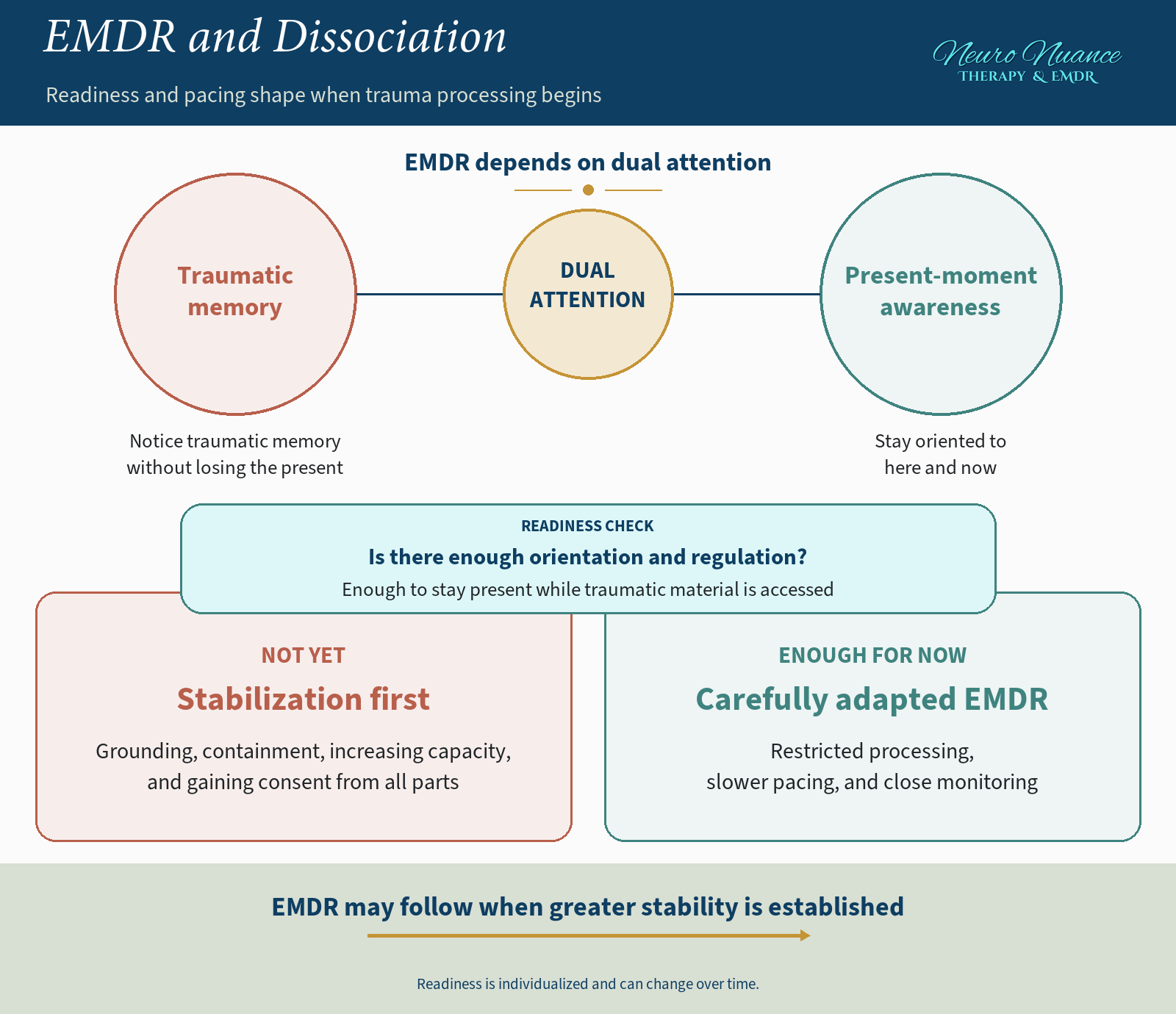
EMDR therapy relies on a balance known as dual attention, the ability to notice aspects of past traumatic memories while remaining oriented to the present. This balance allows trauma processing to occur without overwhelming the nervous system.
When dissociative symptoms are present, maintaining that balance can be more challenging. Activating traumatic memories too quickly may:
pull attention away from the present moment
disrupt awareness of bodily sensations
fragment memory networks rather than integrate them
activate multiple, associated traumatic memories at once, leading to emotional flooding that cannot be resolved in a single session
EMDR uses bilateral stimulation, such as eye movements, to support adaptive information processing, the brain’s natural ability to reorganize and resolve traumatic experiences. To ensure effective treatment, the nervous system needs enough stability to remain present and oriented while those memories are accessed.
Within the adaptive information processing (AIP) model, traumatic memories linked to overwhelming traumatic events are understood as being stuck in their original form rather than being fully integrated.
This is why dissociation matters so much in EMDR therapy. It does not mean EMDR is off-limits. It means the pace, preparation, and structure of EMDR must match the individual’s capacity for regulation and presence. When those factors are respected, trauma processing is more likely to support integration rather than intensify symptoms.
Can EMDR Be Used When Dissociation Is Present?
The short answer is yes, but not always immediately, and not in the same way for everyone.
EMDR therapy can be appropriate for people who experience dissociative symptoms when certain conditions are in place. The most important factor is not the presence of dissociation itself, but whether the nervous system can remain sufficiently oriented and regulated while traumatic material is accessed.
EMDR is more likely to be appropriate when a person:
can stay connected to the present moment for short periods of time
is able to notice early signs of dissociation or overwhelm
has some capacity to use grounding or coping strategies when distress increases
is working with a trauma therapist who is attentive to pacing and safety
In these situations, EMDR can support trauma processing without overwhelming the system.
EMDR may need to be slowed, modified, or postponed when dissociation is frequent, intense, or unpredictable, especially if traumatic memories rapidly activate multiple associated experiences at once, leading to emotional flooding that cannot be contained in a single session. In these cases, moving too quickly into trauma processing can increase dissociative symptoms rather than reduce them.
This does not mean EMDR is ineffective or inappropriate long-term. It means that readiness and sequencing matter. For some individuals, a phase-oriented treatment approach is needed, where stabilization comes first and the treatment of traumatic memories occurs later.
For more information on what readiness looks like for EMDR therapy, read How to Know if You’re ready for EMDR.
How EMDR Is Adapted for Dissociation
When dissociative symptoms are present, EMDR therapy is adapted to support stability, containment, and ongoing orientation to the present moment. These adaptations are not optional additions; they are an essential part of effective trauma treatment when the nervous system has learned to manage threat through dissociation.
One of the most important adaptations involves preparation. Rather than moving quickly into trauma processing, more time may be spent strengthening grounding and coping skills that help a person notice and respond to early signs of dissociation. This preparation supports the ability to remain connected while traumatic memories are accessed, reducing the risk of emotional flooding or fragmentation.
Pacing is another key consideration. For dissociative clients, EMDR sessions are often structured more gradually. Trauma processing may occur in shorter segments, with close attention to how the nervous system responds. Slowing the pace allows memory networks to be engaged without activating too many associated traumatic experiences at once.
EMDR may also be delivered with awareness that different parts of experience can respond to threat in different ways. Those parts may have uneven access to behavior, emotion, physical sensation, and conscious knowledge. Learn more about how EMDR can work when trauma memory is unclear.
Approaching trauma processing with this sensitivity helps maintain safety and reduces internal conflict, without requiring detailed exploration or labeling of parts in many cases. This perspective overlaps with concepts often described as dissociative parts, parts work, or ego state therapy, and is sometimes discussed in approaches such as Internal Family Systems, where strategies can be integrated without requiring formal adoption of any single model.
Throughout this process, maintaining connection to the present moment remains central. The goal of adapting the EMDR process is not to avoid traumatic memories, but to ensure that trauma processing occurs within a window of tolerance where integration is possible. When EMDR is paced and contained in these ways, it can support symptom reduction while respecting the protective role dissociation has played.
Risks of Using EMDR Without Adequate Stabilization
EMDR therapy is a powerful tool for trauma processing, but its effectiveness depends on timing and readiness. When dissociative symptoms are present and EMDR is introduced too quickly, the nervous system may become overwhelmed rather than supported.
One potential risk is emotional flooding. Trauma processing can activate multiple, interconnected traumatic memories at the same time. Without sufficient grounding techniques and containment strategies in place, this activation can exceed a person’s capacity to stay oriented, leading to increased distress during or between EMDR sessions.
Another risk is an increase in dissociative symptoms. If the nervous system perceives trauma processing as unsafe or uncontainable, dissociation may intensify as a protective response. This can appear as greater disconnection from the present moment, reduced awareness of bodily sensations, or difficulty recalling what was discussed in session.
When stabilization is insufficient, EMDR can also disrupt the treatment process itself. Rather than supporting integration, trauma work may feel fragmented or unresolved, making it harder for memory networks to reorganize in an adaptive way. This does not reflect a failure of EMDR therapy, but a mismatch between the approach and the client’s current needs.
These risks are largely preventable. Careful pacing, attention to early signs of overwhelm, grounding methods, and a focus on stabilization allow EMDR to remain both effective and safe for dissociative clients.
When EMDR May Not Be the First Step
For some people who experience dissociative symptoms, EMDR therapy may not be the first step in trauma treatment, and that is not a setback. Sequencing care thoughtfully is often what makes trauma processing effective over time.
When dissociation is frequent or easily triggered, early phases of trauma treatment may focus on strengthening coping strategies, building a sense of safety, and increasing the ability to stay connected to the present moment. This sequencing is commonly reflected in the use of EMDR for Complex PTSD, where safety and stabilization support later trauma processing.
Delaying trauma processing does not mean avoiding it. It means recognizing that readiness matters. For many trauma survivors, taking time to stabilize first reduces the likelihood of emotional flooding, increases confidence in the therapy process, and makes later EMDR sessions more effective.
Importantly, EMDR remains an option even when it is not introduced right away. With the right preparation and support system in place, EMDR therapy can be integrated into treatment at a pace that respects the nervous system’s capacity.
How EMDR Fits Within Trauma Therapy
In clinical practice, EMDR therapy is one component of trauma-informed care, guided by the clinical experience of a trained EMDR therapist rather than applied in isolation. When dissociative symptoms are present, EMDR is most effective when it is thoughtfully integrated into a broader trauma therapy process that prioritizes safety, regulation, and individual needs, often building support and resources outside of therapy first.
At Neuro Nuance Therapy and EMDR, EMDR therapy in Austin, TX is approached as part of a broader trauma therapy process for adults with PTSD, complex trauma, dissociative symptoms, and trauma-related nervous system responses. When dissociation is present, the work may include stabilization, grounding, parts-informed therapy, and careful pacing before deeper memory processing becomes appropriate.
Within trauma treatment, EMDR may be used alongside other therapeutic supports that help strengthen present-moment awareness, coping strategies, and emotional stability. EMDR can be introduced, paused, or adapted as needed based on how a person responds over time.
This flexibility is a strength of trauma-informed care that experienced EMDR clinicians can guide you through. Understanding how EMDR fits within trauma therapy can make it easier to decide whether and when it may be helpful, while respecting the complexity of dissociative experiences.
Frequently Asked Questions About EMDR and Dissociation
-
EMDR does not create dissociation, but if trauma processing moves too quickly, dissociative symptoms can increase as a protective response. This is why screening, pacing, and preparation matter.
-
Not automatically. Dissociation can be compatible with EMDR when the approach is adapted and introduced at the right time. In some cases, stabilization is needed first.
-
Common signs include feeling far away, numb, spaced out, disconnected from your body, or losing track of what was happening.
-
A trauma therapist will typically slow down, reorient you to the present moment, and adjust the process. Dissociation is treated as information about pacing, not failure.
-
Sometimes, but it often requires a phased approach and careful adaptation. EMDR is typically not the first step if dissociation is severe or destabilizing.
If dissociative symptoms are severe, the first phase of care may look more like stabilization-focused dissociative disorders therapy than direct trauma processing.
-
Not perfectly stable, but you generally need enough stability to stay oriented and use grounding strategies when distress increases. Readiness matters more than a fixed timeline.
-
EMDR can be used with dissociation, but it requires careful pacing, preparation, and modifications to maintain stability. In many cases, treatment focuses first on building grounding skills and improving communication between parts of the self before memory processing begins. EMDR therapy for dissociation in Austin at Neuro Nuance Therapy and EMDR is adapted to support stabilization, reduce overwhelm, and allow processing to unfold gradually.
Next Steps
If you experience dissociative symptoms and are considering EMDR therapy, it can be helpful to begin with a conversation rather than a decision. Understanding your individual history, current coping strategies, and how dissociation shows up in your daily life can clarify whether EMDR is appropriate now or whether additional preparation may be beneficial first.
Trauma therapy is not a one-size-fits-all process. For some people, EMDR sessions become an effective part of treatment early on. For others, EMDR is introduced later, once greater stability is in place. Both paths are valid.
The most important next step is one that feels manageable and respectful of your nervous system’s needs.
If you experience dissociative symptoms and are considering EMDR, a consultation can help clarify whether EMDR is appropriate now or whether more preparation would be helpful first. Neuro Nuance Therapy and EMDR provides EMDR therapy in Austin, TX and online EMDR therapy across Texas for adults working with PTSD, complex trauma, dissociation, and trauma-related symptoms. Visit the EMDR Therapy Austin service page or schedule a free 15-minute consultation.
References
van der Hart, O., Nijenhuis, E. R. S., & Steele, K. (2006). The haunted self: Structural dissociation and the treatment of chronic traumatization. W. W. Norton & Company. https://wwnorton.co.uk/books/9780393704013-the-haunted-self
Knipe, J. (2018). EMDR toolbox: Theory and treatment of complex PTSD and dissociation (2nd ed.). Springer Publishing Company. https://doi.org/10.1891/9780826172563
International Society for the Study of Trauma and Dissociation. (2011). Guidelines for treating dissociative identity disorder in adults, third revision. Journal of Trauma & Dissociation, 12(2), 115–187. https://doi.org/10.1080/15299732.2011.537247