
Three Years of EMDR Therapy in Austin, TX: Reflections from Neuro Nuance Therapy and EMDR
Three years ago today, I received the certificate of formation for Neuro Nuance Therapy and EMDR, PLLC. Since entering the field of mental health and addiction recovery in 2014, private practice had always been my dream. Over those years working in treatment centers, I refined that vision into one simple mission:
To help trauma survivors heal by offering high-quality, evidence-based trauma therapy in a deep, attuned, and personalized way only a locally rooted practice can provide.
My work in the treatment field taught me something essential:
trauma is neurobiological, and healing is nuanced.
That’s where the name came from. Neuro Nuance Therapy is grounded in neuroscience and evidence-based protocols, while also creating a safe, relational, and deeply human space that honors the complexity of real life.
When I first began, I didn’t know what to expect. I spent two years slowly building a small caseload outside my full-time position before fully committing to go full time on my own in September 2024.
Over the last year alone, I’ve had the privilege of working with more than 50 clients, delivering 905 sessions of trauma-focused psychotherapy. Roughly half of those clients were local Austin residents meeting in person, with the rest connecting through telehealth from across Texas.
Each hour reinforced something I have come to believe deeply:
Healing isn’t about fixing symptoms. It’s a neurobiological process that unfolds inside a safe, attuned relationship. Symptoms dissipate as a byproduct. Coping skills bridge the gap.
Today, on the three-year anniversary of the practice, I want to share what I’ve learned, what this last year has revealed, and where the next chapter is heading.

The Changing Landscape of Trauma Therapy in Austin
Austin’s demand for trauma-focused care has remained strong and steady, but the type of work people seek has changed.
More people are seeking EMDR by name.
EMDR is no longer viewed as “alternative” or a last resort. Clients arrive already asking about it, usually because someone they know had a powerful experience, or because insight-based therapies helped but didn’t create deeper shifts.
Complex trauma is the rule, not the exception.
C-PTSD, attachment injuries, emotional neglect, and relational trauma make up the majority of what people seek therapy for. Single-incident trauma is now the outlier.
People want explanations and understanding, not labels.
Clients want to understand:
• why they feel “stuck” even with insight
• why their reactions feel automatic
• why talk therapy wasn’t enough, even if they loved their therapist
• why the past is still intruding even after years of discussing it
They sense they’re up against something deeper than their thinking. Learning about the neurobiology of trauma, dissociation, and attachment brings their experience into clarity and allows for self-compassion in ways symptom lists never could.
Nervous system dysregulation drives the symptoms people fear most.
Hypervigilance, shutdown, emotional flashbacks, spirals of shame, these aren’t “thinking errors.” They’re survival patterns encoded in implicit and procedural memory networks, playing out as if the threat is still happening. It’s the “knowing” but still feeling like they have little control that drives many clients to reach out.
Austin is embracing trauma-informed care — but looking for depth.
People in Austin are well informed. They’re moving past surface-level wellness content and “nervous system hacks.” They want sustainable change, not coping tricks. They’re looking for a framework for getting out of survival mode long-term. Many of my clients know more about trauma and therapy than what graduate schools teach.
And that leads to what these years have taught me.

What the Last Three Years of Trauma Work Have Taught Me
After full emersion in trauma-focused psychotherapy this year, I’m more certain than ever of the following:
Trauma healing is nonlinear, but absolutely possible.
The nervous system learns safety through repetition, consistency, gradual shifts, and the capacity to come back from setbacks. Those small shifts often accumulate into pivotal moments that feel almost sudden:
“It’s just different now,” is a phrase I hear often.
I call these moments the “neuro nuance,” nothing particularly new may emerge cognitively, but the body finally believes it. It’s the embodiment of an updated nervous system.
The therapeutic relationship is still the most powerful regulator.
Research continues to affirm this, and my experience does too. Techniques matter, but it’s the relationship that makes them possible.
In complex trauma work, it’s not just building trust between client and therapist, trust and empathy must extend to the parts within the client that protect, avoid, numb, or detach. Internal safety, trust, and self-compassion is what allows for deep processing that is simply not possible otherwise. This kind of preparation prevents retraumatization and sets trauma-specialized work apart from general counseling.
C-PTSD work is fundamentally relational.
It isn’t just about processing memories, it’s about repairing and fortifying the internal models shaped by years of inconsistency or pain. Over the last year I’ve discovered the power of integrating attachment-focused work into the EMDR protocol to move beyond simple desensitization and help facilitate corrective experiences. It’s not always about what happened, it’s often more about what didn’t happen, and should have.
Predictive processing explains why trauma feels “current.”
The field has begun a long overdue update on how we conceptualize trauma in the brain, moving beyond the outdated “triune brain” model of reptilian, mammalian, and neocortex, into the computational neuroscience of predictive processing. Research is revealing that lack of coherence between what is cognitively known and what is unconsciously detected and predicted is what keeps traumatic memories feeling like a present experience. Brain networks account for this much more accurately than assigning discreet functions to specific brain regions. The concepts of the past were correct, but the neuroscience is catching up.
EMDR works because it brings coherence between cortical and subcortical systems.
Not by erasing memories, but by helping the mind notice the memory and the safety of the present at the same time, until the memory reconsolidates as something that belongs in the past. When the loop closes, the system can relax.

How EMDR Became the Heart of The Practice
When I began this work, there were many evidence-based options for PTSD to choose from. Over time, I found EMDR to be a reliable, flexible, and deeply effective approach for trauma-stored in the nervous system.
EMDR does what trauma work requires:
reduces physiological activation
restores adaptive memory networks
integrates fragmented experiences
reconnects people with agency
aligns with the brain’s natural learning and memory systems
Over the last three years, EMDR has proven something again and again:
When the brain feels safe enough to reprocess, it knows what to do.
My job is not to force change, but to create the conditions that allow it.

The Six Pillars: A Framework That Emerged From Necessity
EMDR doesn’t require homework, but I found myself looking for ways to strengthen healing between sessions. After reading research by Sugden & Merlo (2024) showing the impact of lifestyle medicine on the gut-brain axis in trauma survivors, the Six Pillars of Holistic Trauma Recovery took shape.
Nutrition, Movement, Sleep, Stress Regulation, Social Support, and Toxin-Free Living became an organized way to support clients in the practical areas that significantly influence nervous system recovery.
The Pillars aren’t a rigid protocol, they’re a map.
Across hundreds of cases, a pattern became clear:
the nervous system struggles to heal with a single intervention alone.
But when the foundations are supported, EMDR works more smoothly, and integration holds more firmly.
Healing is enhanced by:
adequate nourishment
movement that supports regulation
consistent sleep rhythms
manageable stress load
relationships that promote safety
reducing neurotoxic substances that exacerbate symptoms
The Pillars are a foundation, not a replacement for therapy, a way of reclaiming the basics that trauma often disrupts.
Milestones From the Last Year
Looking back at 2024–2025, a few milestones stand out:
✔ 50 clients served
Each one with a unique story, teaching me more about trauma and healing than any textbook could.
✔ 905 sessions conducted
A year of deep, sustained clinical work with clients committed to long-term healing.
✔ Expansion of trauma education resources
The website evolved into a neuroscience-informed EMDR resource hub visited globally.
✔ Featured in multiple publications
Psychology.org, Hushmail Blog, Oar Health, and others shared the practice’s insights.
✔ Professional service
I joined the Veterans Health and Wellness Foundation board and supported grant-funded education on chronic pain and opioid use disorder.
✔ Expansion of locations
In addition to the north Austin office, I began seeing clients one day per week in southwest Austin to increase accessibility.
This year wasn’t just busy, it was transformative for clients, myself, and the practice.

Looking Ahead: What’s Coming in Year Four
The next chapter of Neuro Nuance Therapy will focus on:
→ Expanding neuroscience-informed EMDR education
More trauma resources, more conceptual frameworks, and more between-session support tools.
→ Potential practice expansion
As demand grows, I’m exploring adding clinicians who share a trauma-specialized, neuroscience-grounded approach.
→ Professional training opportunities
After increased interest from the community, I’m considering developing continuing education and training on the intersection of addiction and trauma.
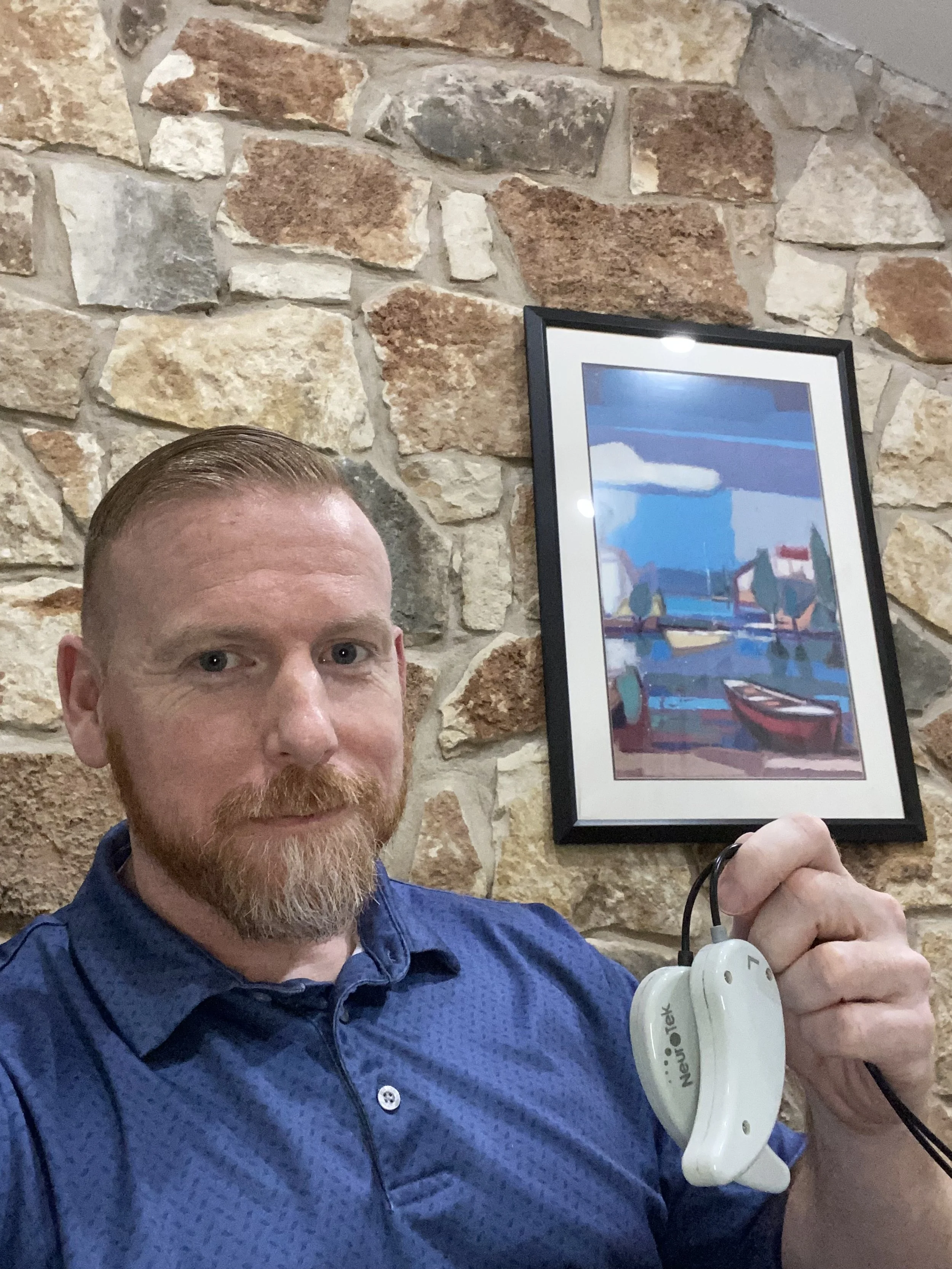
Me with my NeuroTek tappers, used for bilateral stimulation (BLS) during EMDR. If I look like I’m smirking it’s because I’m thinking about the time a client laughed at how goofy they are, but then went on to experience some serious change.
A Final Word of Gratitude
Most of all, today is a moment of gratitude.
To every person who reached out in the last three years, thank you for trusting me with your history, your fears, your healing, and your hope.
To my Austin therapy and treatment colleagues who believed in me and trusted me with your referrals, your support means more than you know.
It is an honor to do this work.
Here’s to year four, and to all the healing still ahead.
Sincerely,
Alex Penrod, MS, LPC, LCDC
EMDR Therapist | Founder
Neuro Nuance Therapy and EMDR, PLLC
Austin, TX

Comments (0)