

Can EMDR Work If You Don’t Remember Your Trauma?
Alex Penrod, MS, LPC, LCDC — Founder & EMDR Therapist | Neuro Nuance Therapy and EMDR, PLLC
Yes. EMDR can sometimes help when a person does not have a clear or complete memory of what happened. In my work as an EMDR therapist in Austin, TX, I’m asked this question quite frequently. So I’ve dedicated this page to providing a more satisfying answer than, “it depends.”
A person may remember only pieces of an experience, feel intense emotions without seeing a scene, or have physical reactions that seem disconnected from any known event. Treatment may eventually work with a current trigger, emotional flashback, negative belief, body sensation, behavioral response, or partial memory.
However, difficulty remembering also calls for caution.
Memory gaps do not automatically mean that someone has a dissociative disorder. Childhood memories naturally vary, repeated experiences can blur together, and some events may never have formed into a detailed autobiographical story. At the same time, unusually fragmented or inaccessible memories can indicate that parts of an experience are not fully connected.
Significant dissociation can be difficult to recognize at the beginning of therapy. People may not identify their experiences as dissociation, and protective patterns can remain hidden until treatment approaches material that has been kept outside ordinary awareness. Difficulty remembering is not evidence by itself that someone has structural dissociation, but it can justify more careful assessment when other dissociative signs are present (International Society for the Study of Trauma and Dissociation [ISSTD], 2011).
When significant dissociation remains possible but is not yet fully understood, the safer approach is to use dissociation-informed precautions until the person’s responses indicate that a less restrictive approach is appropriate.
Why Unclear Memories Change the Approach to EMDR
Eye Movement Desensitization and Reprocessing (EMDR) follows eight phases that begin with history taking, treatment planning, preparation, and stabilization before moving into target assessment and reprocessing. EMDR also understands memories as networks involving sensory information, thoughts, emotions, beliefs, and body sensations. A complete verbal account is not the only way a distressing experience can remain active (Shapiro, 2018).
The clinical question is not simply whether something is available to target. The therapist also needs to understand why only part of the experience is available, what it may be connected to, and what could happen if it is approached.
A fragment may appear small while remaining connected to a much larger network of traumatic experience. Thomas Zimmerman, Ms.Ed., LPCC, an EMDR clinician, trainer, and author of EMDR With Complex Trauma, uses a boat-and-whale metaphor to describe the risk of approaching more traumatic material than a person’s available resources can hold:
“You cannot land a memory the size of a whale into adaptive information the size of a canoe.”
(Zimmerman, 2024, p. 12)
The point is not that every body sensation, emotion, or partial image conceals an enormous trauma. It is that the therapist may not yet know what has been hooked. A seemingly limited fragment could remain relatively contained, or it could provide access to a much larger network involving other memories, emotions, physical reactions, and dissociative parts.
Careful assessment helps determine whether the person has enough present-day stability, internal cooperation, and adaptive information to approach what may be connected to it.
A person may have difficulty remembering because:
the experience happened very early in life;
similar events occurred repeatedly and blended together;
facts are remembered without emotional connection;
strong emotion or physical activation interferes with recall;
avoiding greater awareness has helped the person continue functioning;
or different aspects of the experience are available in different internal states.
The last possibility can be understood through the clinical theory of structural dissociation. This framework describes how overwhelming experiences may interfere with the usual integration of memory, emotion, bodily responses, survival reactions, and a person’s sense of self. Some internal states remain focused on daily life, while others carry trauma-related emotions, reactions, or information (Steele et al., 2005; van der Hart et al., 2006).
These relatively separate internal states are often called parts. Parts language does not automatically mean that someone has dissociative identity disorder. Internal separation can occur in different degrees, with greater separation generally requiring more careful assessment, preparation, and pacing.
This distinction is important because EMDR can activate associations beyond the piece a person initially intends to approach. If a body sensation, emotion, image, or belief is connected to material held outside ordinary awareness, unrestricted processing may lead to flooding, shutdown, loss of present orientation, increased amnesia, or strong reactions from other parts of the internal system (ISSTD, 2011; Shebini, 2019).
A therapist does not need to assume that every person with unclear childhood memories has a complex dissociative condition. The safer position is to avoid assuming that an apparently simple symptom is uncomplicated before enough assessment has occurred.
Why You May Have Trauma Reactions Without a Clear Memory
People often think of memory as a story that can either be remembered or forgotten. Trauma-related experience may be available more unevenly.
Someone may know that an event occurred but feel emotionally detached while discussing it. Another person may feel terror, shame, or helplessness without knowing what those emotions are connected to. Someone may experience pain, freezing, an urge to escape, or a brief sensory image without being able to place it within a sequence.
A few definitions help clarify these differences.
Autobiographical memory is a person’s conscious recollection of events within the story of their life.
Explicit memory is information that can be deliberately brought to mind and described.
Implicit memory refers to learning and reactions that influence the present without necessarily appearing as conscious recollection. A person might automatically freeze, submit, avoid, or become alarmed before understanding why.
Dissociation involves a disruption in the usual connection among memory, emotion, bodily experience, perception, identity, or awareness.
The BASK Model of Dissociation
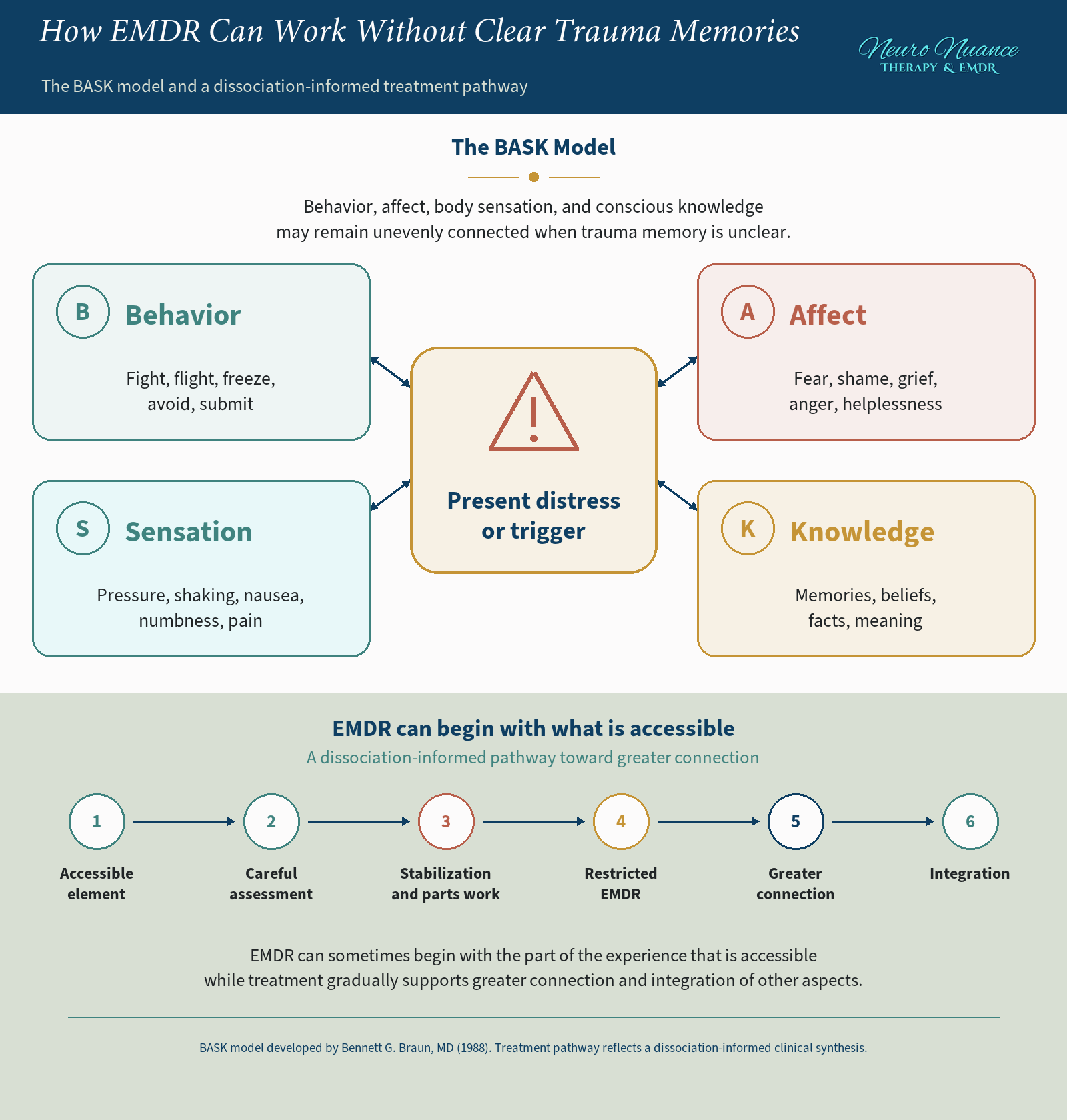
The BASK model offers a useful clinical framework for understanding how parts of an experience may remain disconnected. Developed by psychiatrist Bennett Braun, MD, BASK stands for Behavior, Affect, Sensation, and Knowledge (Braun, 1988a).
Behavior includes what a person did during an experience, what they automatically do now, or what they feel compelled to do.
A person may freeze during conflict, become intensely compliant around authority, leave relationships when closeness develops, repeatedly check for danger, or feel an immediate urge to hide. The behavior may continue to serve a protective function even when its original context is unavailable.
Affect is the emotional component.
Fear, shame, grief, anger, disgust, helplessness, or abandonment may enter awareness without a clear memory attached to them. An emotional flashback can feel as though an earlier emotional reality has returned even when no visual scene appears.
Sensation includes physical and sensory experience.
A person may notice pressure in the chest, constriction in the throat, pain, nausea, shaking, numbness, heat, cold, or fragments of sound, smell, touch, and body position. These reactions can be clinically meaningful without proving that any particular event occurred.
Knowledge includes what the person consciously remembers, believes, understands, or recognizes.
Someone may know that abuse occurred but have no images. Another person may remember an image without knowing where it fits. A person may carry a belief such as “I am trapped” or “I am not safe” without having a clear account of how it developed.
Knowledge does not necessarily mean complete or perfectly accurate recall. It refers to what is consciously understood, believed, or remembered at a given time.
The four elements can appear together or become unevenly accessible. A person may automatically freeze during conflict (behavior), feel terror without knowing why (affect), experience pressure in the chest (sensation), and have little conscious access to the experiences that shaped the reaction (knowledge).
Jim Knipe, PhD, is a psychologist, longtime EMDR clinician, EMDRIA-approved consultant and instructor, and author of EMDR Toolbox: Theory and Treatment of Complex PTSD and Dissociation. His work extends EMDR methods to address dissociation, psychological defenses, internal conflict, and avoidance in people with complex trauma.
Knipe describes how people may have sensations without knowledge, knowledge without images, or images without emotional access when elements of an experience are dissociated from one another. His clinical procedures may focus on the accessible BASK element, the person’s urge to avoid it, or the protective function of what remains unavailable (Knipe, 2019).
The BASK model should not be understood as proof that memories are physically stored in four separate neurological compartments. It is a clinical way of describing experiences that would ordinarily be connected but are available unevenly.
Research more consistently supports people’s subjective experience of trauma memories as fragmented than it supports the conclusion that trauma narratives are always objectively fragmented or disorganized (Bedard-Gilligan & Zoellner, 2012).
An accessible BASK element can help identify a possible entry point. Before using it as an EMDR target, the therapist still needs to understand how it relates to the person’s broader internal organization.
Why Not Knowing Can Be Protective
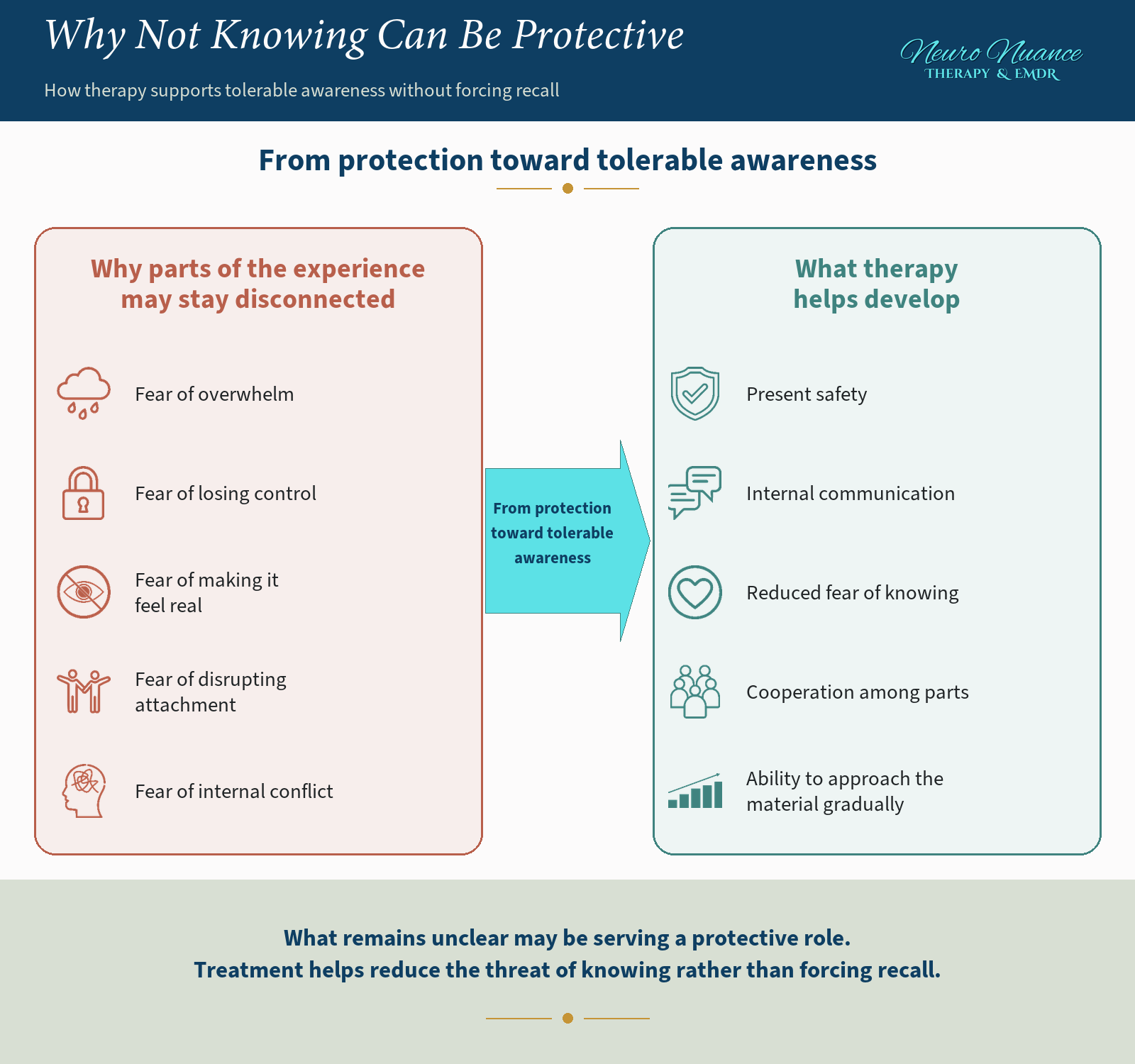
Fuzziness, numbness, confusion, and avoidance can have a function.
A person may fear that remembering would make an experience too real. Feeling its emotional impact may seem likely to interfere with work, parenting, relationships, sleep, or daily functioning. Greater awareness might challenge a lifelong attachment to a caregiver or change how the person understands their family.
A protective internal state, sometimes described as a part, may expect that knowing more will lead to punishment, loss of control, unbearable grief, self-harm, internal conflict, or permanent destabilization.
In these situations, the missing information is not simply an empty space waiting to be filled. The separation may be part of how the person survived. A protection that was once adaptive may continue automatically even after the original danger has ended.
Knipe’s work asks what is protective about not having access to an image, emotion, sensation, or piece of knowledge. One person might recognize that not seeing the images has helped keep the experience from feeling fully real. Another might fear that feeling the emotion would make it impossible to continue functioning (Knipe, 2019).
Parts work can help the therapist and client understand this protective logic. It should not be used to interrogate a hidden part, demand details, or bypass internal objections.
Instead, parts-informed work may help:
identify what a protective part expects will happen;
reduce fear and internal conflict;
strengthen awareness of current safety;
improve communication among internal states;
and develop enough cooperation for treatment to proceed without violating the boundaries that have kept the person functioning.
The more useful question is not, “How do we make the memory come back?”
It is, “What would need to change for this part of the experience to feel less dangerous to know?”
What Needs to Be Assessed Before Processing
Before using EMDR on an accessible fragment, the therapist needs enough understanding of the person’s current stability, dissociative symptoms, and internal organization to determine whether they are ready for EMDR processing.
Connection to the Present
Can the person remain aware of:
the therapy room;
their current age;
the difference between then and now;
and their ability to pause or stop?
A person may appear oriented at the beginning of a session but lose that connection rapidly once traumatic material becomes active. Present orientation may need to be strengthened repeatedly rather than checked only once.
Stability During and Between Sessions
Can the person manage distress without severe deterioration in daily functioning?
The therapist considers sleep, self-harm risk, substance use, impulsive behavior, emotional regulation, access to support, and the person’s ability to contain unfinished material between sessions.
Dissociative Symptoms
Assessment may include signs such as:
depersonalization or derealization;
lost time;
state-dependent memory;
abrupt changes in emotion, behavior, voice, posture, or sense of self;
internal voices or conversations;
and information that appears available in one state but not another.
A coherent intake presentation, strong daily functioning, or a low screening score does not always exclude significant dissociation. Assessment continues as treatment develops (ISSTD, 2011).
Internal Cooperation
Do parts of the person agree to the proposed work, or is there fear, opposition, threat, or anticipated retaliation?
Agreement does not require every part to feel completely comfortable. It does require enough cooperation that processing is not experienced as an internal violation.
Organization of the Target
The therapist needs some understanding of:
which BASK element is accessible;
who experiences or holds it;
what other elements may be connected;
whether different parts hold different portions of the experience;
and how likely the target is to spread into additional material.
Different parts may hold parallel components of the same moment, such as fear, physical pain, visual information, and avoidance. They may also hold consecutive segments of an event. Clinical literature on EMDR with DID recommends understanding these relationships as much as possible before reprocessing because the organization influences what may become activated (Shebini, 2019).
The therapist does not need complete knowledge of every part or every fragment before any therapeutic work can occur. The aim is to understand enough to avoid bypassing known protections or opening material that cannot yet be contained.
How Treatment May Proceed When Memory Is Fragmented
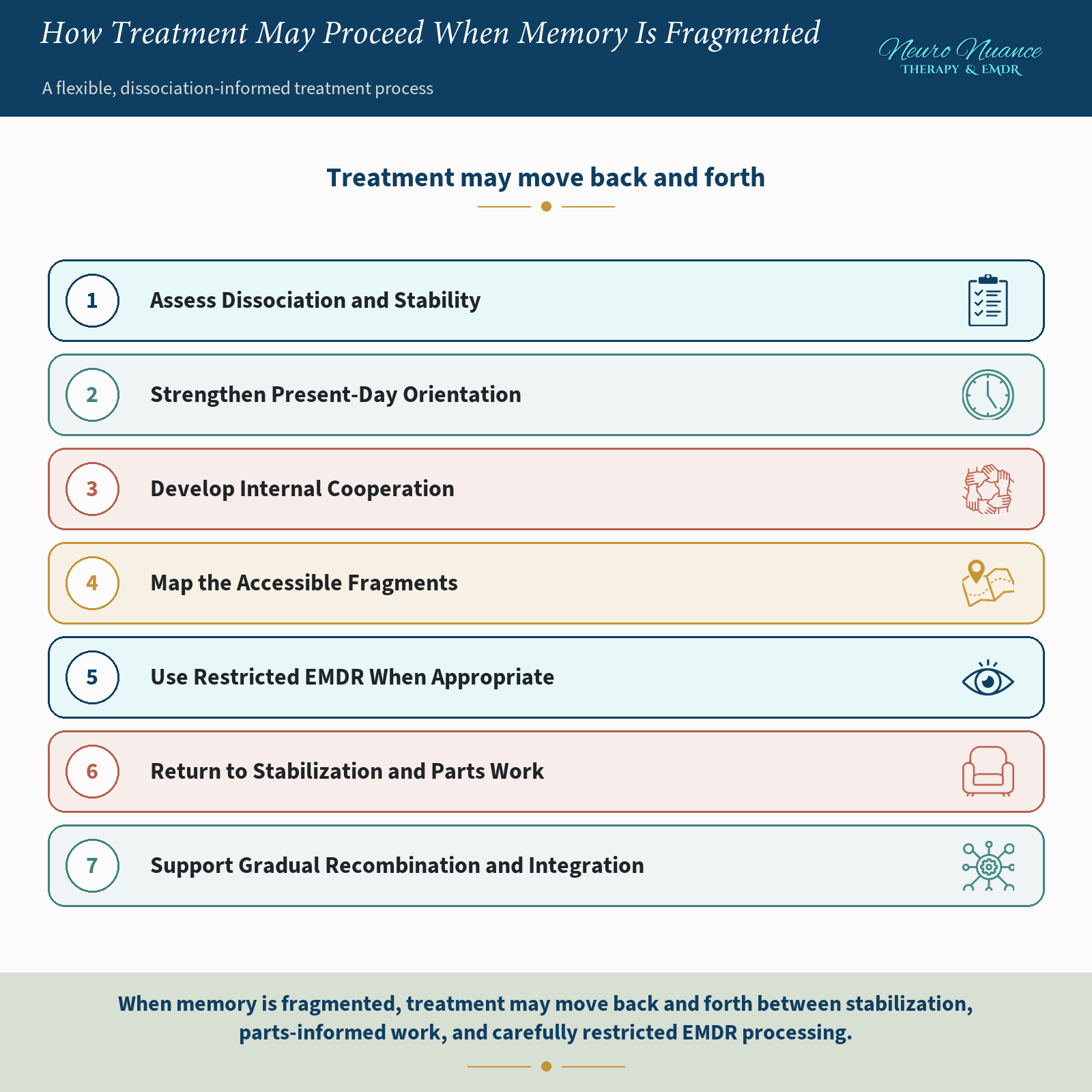
When dissociation is suspected, treatment usually begins by improving the person’s ability to remain connected to the present while noticing internal experience.
Preparation is not simply a waiting period before the “real” EMDR begins. It establishes the conditions that allow traumatic material to be approached without the person losing choice, orientation, or stability.
The EMDR model emphasizes history taking, preparation, stabilization, and the ability to maintain dual awareness before reprocessing. The ISSTD guidelines similarly recommend phase-oriented treatment for DID and related dissociative conditions, with trauma processing approached only after sufficient attention to safety, symptom reduction, internal cooperation, and tolerance for the work (ISSTD, 2011; Shapiro, 2018; Steele et al., 2005).
Stabilization and Present-Day Orientation
Treatment first develops grounding, containment, emotional regulation, access to supportive internal or external resources, and reliable ways to slow or stop the work.
For someone vulnerable to dissociative absorption, switching, or collapse, the sequence may involve brief contact with difficult material followed by an immediate return to present-day orientation. The therapist may repeat this movement many times before longer periods of processing become appropriate.
Internal Communication and Cooperation
Before approaching a fragment, the therapist explores who or what inside may be affected.
A protective part may have concerns about the target, bilateral stimulation, how much information could emerge, or what will happen after the session. These concerns need to be addressed before processing rather than discovered only after the system has become destabilized.
The purpose is not to overpower the protection. It is to develop enough shared understanding and control for limited contact to become possible.
Mapping the Accessible Elements
The therapist and client identify what is currently available:
behavior;
emotion;
sensation;
knowledge;
image;
belief;
present trigger;
or defensive urge.
They also consider what appears absent, who may hold it, and whether another part is likely to react when the available fragment is approached.
The goal is not to reconstruct the entire event. It is to understand enough of the organization to choose a restricted target and recognize where the work could spread.
Restricted EMDR on an Accessible Fragment
When sufficient stability and cooperation are present, EMDR may focus on one contained element.
The target might be:
fear attached to a current trigger;
a body sensation;
a negative belief;
an isolated image;
an urge to flee or disappear;
avoidance of knowing;
or one limited segment of an experience.
Modifications may include shorter sets of bilateral stimulation, frequent pauses, repeated orientation to current surroundings, fractionating the target into smaller pieces, and limiting associative spread. The person and therapist may agree in advance about what will remain outside the work (ISSTD, 2011; Shebini, 2019).
Returning to Stabilization and Parts Work
Treatment may move back and forth rather than proceeding through one uninterrupted course of memory processing.
After limited EMDR, the therapist evaluates what changed:
Did the disturbance decrease?
Did another part react?
Did new material enter awareness?
Did the person remain stable after the session?
Does the system need more preparation before continuing?
The focus may return to containment, communication, or reducing the fear of knowing before another fragment is approached.
This can look like a little here and a little there. One part of therapy reduces the threat associated with greater awareness. Another lowers the disturbance connected to a specific BASK element. The therapist then pauses, restores cooperation, and determines whether the next step should involve further stabilization, another fragment, or greater connection among the elements already addressed.
Moving From Reduced Disturbance Toward Integration
Several levels of change may occur.
Reduced disturbance means that one emotion, sensation, image, belief, or defensive urge becomes less intense.
Greater connectionmeans that previously separated elements can be experienced together without overwhelming the person.
Integration means that the experience becomes connected with present-day knowledge, adaptive information, and recognition that the danger belongs to the past.
Desensitizing one fragment can reduce suffering. It does not always mean that the broader experience has been fully reprocessed. This distinction can also help explain why EMDR sometimes stalls or produces movement without integration.
As the system becomes less afraid of the material and the fragments become less disturbing, greater connection may become possible. A person may gradually know what happened while remaining emotionally present, feel an emotion without being consumed by it, or recognize a physical reaction as belonging to an earlier experience rather than current danger.
Fuller integration does not require every missing detail to return. It requires enough connection among the relevant elements for the experience to become part of the person’s history instead of continuing to intrude as disconnected reliving (ISSTD, 2011; Shebini, 2019).
Will EMDR Uncover Missing or Repressed Memories?
EMDR is not a memory-recovery procedure, and it cannot determine whether an emerging image, sensation, or association is historically accurate.
New material may enter awareness during therapy. A person might notice a partial image, physical reaction, emotion, or connection that had not previously been conscious. A familiar event may begin to feel more real, or pieces that once seemed unrelated may begin to fit together.
None of this automatically confirms what happened.
An image may reflect an accurate autobiographical memory, a partial recollection, an inference, symbolic material, a fear, or a blend of several experiences. A body sensation may be useful to work with while its origin remains uncertain.
An image, sensation, or association can be therapeutically useful without being treated as verified historical evidence.
A responsible therapist avoids supplying details, treating uncertainty as proof, or suggesting that symptoms reveal a specific hidden event. Recovered or emerging memories cannot be classified automatically as either accurate recollections or false constructions.
Their meaning and reliability depend partly on how they emerged, whether suggestion was involved, and how the material changed through later reflection or discussion. Neutral language allows therapy to address the person’s distress without forcing uncertain experience into either conclusion (Dodier et al., 2023; ISSTD, 2011).
A person does not need to decide exactly what every fragment represents before the associated distress can be addressed.
Healing Does Not Require Perfect Memory
A person may continue to have unanswered questions while experiencing fewer emotional flashbacks, less physical distress, greater internal cooperation, healthier relationships, and a stronger ability to recognize that past danger is not occurring now.
The aim is not to recover a flawless chronological account. It is to help the person experience more choice, connection, and freedom from reactions that once felt automatic and uncontrollable.
At Neuro Nuance Therapy and EMDR, unclear memories are approached with curiosity, caution, and respect for the protective function of dissociation. Treatment begins by understanding how a person’s experience is organized rather than pressuring them to remember.
When EMDR is appropriate, it can be combined with stabilization and parts-informed work so that processing remains contained and integration develops at a tolerable pace.
A consultation can help clarify whether direct EMDR processing, parts-informed preparation, or additional stabilization is the safest place to begin. Neuro Nuance provides in-person EMDR therapy in Austin and telehealth for adults throughout Texas.
Frequently Asked Questions
-
Not having full access to a specific trauma memory does not rule out EMDR. Treatment may begin with a current trigger, emotional flashback, body sensation, negative belief, behavioral reaction, or partial memory.
When the origin is unclear, the therapist first considers whether dissociation, ordinary memory limitations, medical factors, or another issue could make direct processing unsafe. An accessible reaction can provide a starting point, but it should not be approached without understanding what it may be connected to.
-
A body sensation can become part of an EMDR target, but it should not automatically be treated as a simple or isolated symptom.
The therapist considers its context, possible medical explanations, associated emotions, dissociative symptoms, and whether other parts of the person may be affected by approaching it. Processing a body sensation can be therapeutically useful without uncovering full access to other associations.
-
An emotional flashback may provide a useful entry point. Treatment can begin with a recent episode and identify the emotion, physical reaction, belief, and protective urge connected to it.
The therapist does not need to assume that the flashback proves a particular forgotten event. When dissociation is suspected, the emotional reaction is approached carefully and with attention to present orientation, internal cooperation, and the person’s ability to contain what emerges.
-
Childhood memory gaps have many possible explanations and do not automatically indicate trauma, dissociative amnesia, or a dissociative disorder.
When the gaps are extensive or occur alongside depersonalization, derealization, lost time, emotional flashbacks, abrupt state changes, or other dissociative symptoms, the therapist may use more conservative assessment, stabilization, and pacing before attempting direct memory processing.
-
EMDR may be followed by new associations or fragments entering awareness, but recovering memories is not its purpose and cannot be guaranteed.
Treatment should not pressure someone to remember or present uncertain material as verified history. Images, sensations, and associations may be worked with while their meaning or historical accuracy remains uncertain.
A responsible therapist allows clients to come to their own personal conclusions about their history rather than attempting to verify anything.
-
No. People can experience significant improvement without recovering every detail.
Healing may involve less distress, fewer automatic reactions, better communication among parts, greater connection to the present, improved relationships, and more freedom in daily life. A complete chronological memory is not required for the past to become less intrusive.
References
Bedard-Gilligan, M., & Zoellner, L. A. (2012). Dissociation and memory fragmentation in posttraumatic stress disorder: An evaluation of the dissociative encoding hypothesis. Memory, 20(3), 277–299. https://doi.org/10.1080/09658211.2012.655747
Braun, B. G. (1988a). The BASK model of dissociation. Dissociation, 1(1), 4–23. https://hdl.handle.net/1794/1276
Braun, B. G. (1988b). The BASK model of dissociation: Part II, treatment. Dissociation, 1(2), 16–23. https://hdl.handle.net/1794/1340
Dodier, O., Barzykowski, K., & Souchay, C. (2023). Recovered memories of trauma as a special (or not so special) form of involuntary autobiographical memories. Frontiers in Psychology, 14, 1268757. https://doi.org/10.3389/fpsyg.2023.1268757
International Society for the Study of Trauma and Dissociation. (2011). Guidelines for treating dissociative identity disorder in adults, third revision. Journal of Trauma & Dissociation, 12(2), 115–187. https://doi.org/10.1080/15299732.2011.537247
Knipe, J. (2019). EMDR toolbox: Theory and treatment of complex PTSD and dissociation (2nd ed.). Springer Publishing Company.
Shapiro, F. (2018). Eye movement desensitization and reprocessing (EMDR) therapy: Basic principles, protocols, and procedures (3rd ed.). Guilford Press.
Shebini, N. (2019). EMDR for safe desensitization of memories and fusion of parts in DID: Conference room technique, trauma mapping and management of unplanned abreactions. Frontiers in the Psychotherapy of Trauma & Dissociation, 3(2), 136–150. https://doi.org/10.46716/ftpd.2019.0030
Steele, K., van der Hart, O., & Nijenhuis, E. R. S. (2005). Phase-oriented treatment of structural dissociation in complex traumatization: Overcoming trauma-related phobias. Journal of Trauma & Dissociation, 6(3), 11–53. https://doi.org/10.1300/J229v06n03_02
van der Hart, O., Nijenhuis, E. R. S., & Steele, K. (2006). The haunted self: Structural dissociation and the treatment of chronic traumatization. W. W. Norton & Company.
Zimmerman, T. (2024). EMDR with complex trauma. https://emdrwithcomplextrauma.com