

EMDR Working Memory Theory: How Eye Movements May Change Memory Recall
Alex Penrod, MS, LPC, LCDC — Neuro Nuance Therapy and EMDR, PLLC | Austin, TX
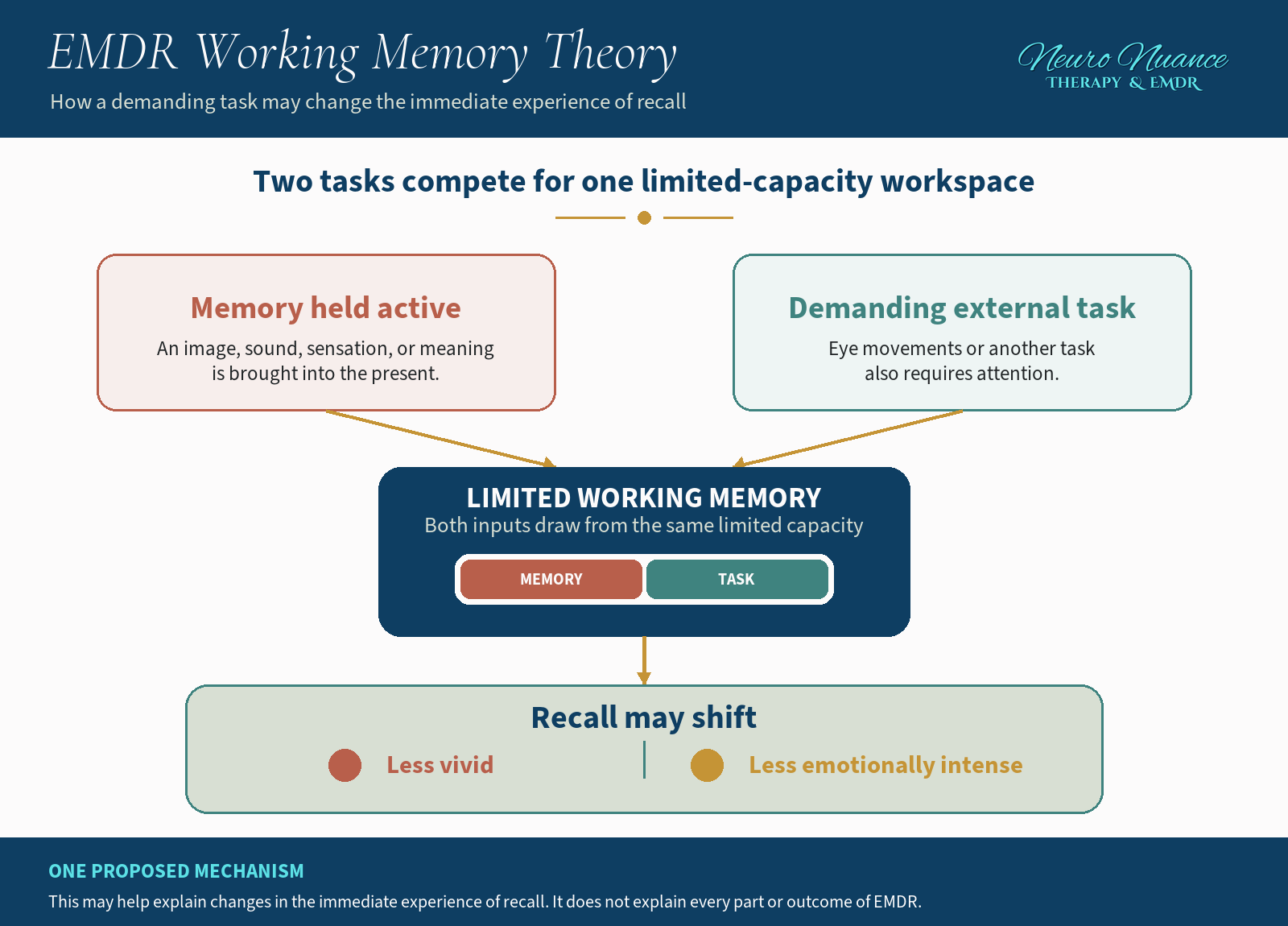
Working Memory Theory proposes that bilateral stimulation during Eye Movement Desensitization and Reprocessing (EMDR) can be understood as creating competition for limited mental resources. A traumatic memory may remain stored in long-term memory for years, but experiencing it vividly again requires the brain to bring parts of it back into active processing. When recall is paired with a second demanding task, such as rapid eye movements, the two tasks compete for working memory. The memory may then become harder to hold with the same vividness and emotional intensity.
That makes Working Memory Theory unusually testable. It also keeps the claim narrow: working-memory taxation can help explain what may happen to memory vividness and emotionality during the desensitization phase of EMDR, but it does not by itself explain every change that occurs during EMDR reprocessing.
As an EMDR therapist in Austin, TX, I’ve watched Working Memory Theory gain momentum as one of the leading explanations for the mechanism behind eye movements and bilateral stimulation. This page will explore the theory, the state of the evidence, and the implications for how we understand EMDR’s effectiveness.
EMDR Working Memory Theory: Quick Summary
- Working memory has limited capacity. It is used to hold and manipulate information that is active right now.
- A dual task creates competition for mental resources. Recalling a distressing memory while doing a second demanding task can reduce memory vividness, emotionality, and emotional intensity.
- Bilateral stimulation, dual attention, and working memory taxation are not the same thing. They describe different features of EMDR and should not be treated as synonyms.
- Working-memory competition is one proposed EMDR mechanism. Research supports it as an explanation for some changes during recall, not as a single complete explanation for the therapy.
-
What does working memory have to do with a traumatic memory?
How could eye movements change the vividness and emotionality of a memory?
Are bilateral stimulation, dual attention, and working-memory taxation the same thing?
Why compare eye movements with tones, tapping, and counting?
How does Working Memory Theory fit with the Adaptive Information Processing model?
Does Working Memory Theory explain reconsolidation, fear extinction, or REM sleep?
What Does Working Memory Have to Do With a Traumatic Memory?
Long-term memory stores information across time. Working memory is the temporary mental workspace used when some of that information is brought online and actively held, compared, imagined, or manipulated. Remembering an old event is therefore not the same as opening an untouched recording. The brain reconstructs enough of the event for it to become mentally present again.
That distinction is especially relevant to traumatic memories, intrusive memories, and other aversive memories. A person can know that something happened years ago while a recalled image, sound, bodily sensation, or sense of danger still feels immediate. Working Memory Theory focuses on what happens while that representation is active rather than on how the memory was originally stored.
Alan Baddeley's working memory model describes limited resources involved in attention and in verbal and visuospatial processing. The practical prediction is straightforward: if two demanding tasks rely on overlapping cognitive resources, doing them simultaneously should create interference.
How Could Eye Movements Change the Vividness and Emotionality of a Memory?
Consider a person who survived a serious collision. When the memory is activated, the instant before impact may still appear sharply: the other car entering the intersection, the sense of being trapped, the surge of fear. During an EMDR desensitization set, the person brings the target to mind while following the therapist's hand with rapid eye movements.
Maintaining that internal scene requires attention. Tracking the moving target does too. Working Memory Theory predicts that this concurrent cognitive load creates competition for a limited resource, making it harder to sustain the memory with its original clarity and emotional intensity. Researchers often call this working-memory taxation.
Reductions in vividness and emotionality are not the same outcome. An image may become fuzzier, farther away, or harder to hold while some distress remains, or emotionality may fall even when the person can still describe the event clearly. Neither means the autobiographical memory has been erased; the experience of recalling the memory has changed. In my experience working with clients who have PTSD, this reduction in vividness and emotional intensity is a welcome change.
Are Bilateral Stimulation, Dual Attention, and Working-Memory Taxation the Same Thing?
They overlap in EMDR practice, but they describe different properties of the procedure. This distinction is central to Working Memory Theory because a stimulus can be bilateral without being especially demanding, while a demanding secondary task can tax working memory without being bilateral at all.
Bilateral Stimulation, Dual Attention, and Working-Memory Taxation
| Term | What it describes | Why the distinction is useful |
|---|---|---|
| Bilateral stimulation | The stimulus alternates across sides, such as side-to-side eye movements, alternating taps, or auditory cues. | Describes the pattern of stimulation. |
| Dual Attention | Attention is divided between internally activated material and an external present-moment task or stimulus. | Describes the attentional arrangement. |
| Working-memory taxation | The secondary task consumes limited cognitive resources while the memory is active. | Describes the cognitive demand proposed by Working Memory Theory. |
What Does the Research Actually Support?
Across laboratory and clinical research, the most consistent finding is specific: recalling an unpleasant or traumatic memory while performing a concurrent task can reduce how vivid and emotionally intense that memory feels. A 2018 systematic review found reasonable empirical support for the working-memory account among proposed EMDR mechanisms (Landin-Romero et al., 2018), and a later review of 11 studies found that dual-task conditions generally reduced vividness and emotionality relative to control conditions (Wadji et al., 2022).
The boundary is just as important as the effect. Clinical trials do not show that eye movements uniquely explain every EMDR outcome. Sack et al. (2016) found benefits from an external visual focus without a specific advantage for moving-eye tracking, and Susanty et al. (2024) found no added neurocognitive improvement from eye-movement desensitization over retrieval alone. The strongest claim is therefore that working-memory competition is well supported for changes in the immediate experience of recall, not that it explains the full therapeutic effect of EMDR for Posttraumatic Stress Disorder (PTSD).
What the Research Shows
| Study | Sample | Finding | How to interpret it |
|---|---|---|---|
| de Jongh et al., 2013 | 64 clinical patients: 32 with PTSD, 32 with other diagnoses | Eye movements reduced emotionality more than recall alone; tones showed an intermediate trend. | Supports a working-memory effect in a clinical sample, not only in analogue laboratory tasks. |
| Sack et al., 2016 | 139 patients with PTSD | Moving-eye tracking and stationary visual fixation both outperformed exposure without an explicit external visual focus; eye movements did not outperform fixation. | Suggests that dual attention or external focus may contribute alongside eye movement-specific effects. |
| Wadji et al., 2022 | Review of 11 studies | Dual-task conditions generally reduced vividness and emotionality compared with control conditions; limited follow-up evidence tempered durability claims. | Supports the mechanism for immediate memory effects while identifying an evidence gap. |
| Susanty et al., 2024 | 91 adults with PTSD | Eye-movement desensitization did not add neurocognitive improvement over retrieval alone on working memory, verbal learning, or executive-function outcomes. | Shows why immediate memory effects should not be generalized to every cognitive or treatment outcome. |
Why Compare Eye Movements With Tones, Tapping, and Counting?
Working Memory Theory predicts that eye movements are not the only way to create interference. If cognitive competition is doing part of the work, other tasks should also affect recall when they consume enough of the relevant resources. Researchers have therefore compared eye movements with auditory cues, tapping sequences, counting, and other tasks while also testing whether sensory modality changes the effect.
Those comparisons show why 'bilateral' and 'equivalent' are not the same thing. Van den Hout, Engelhard, and colleagues found eye movements more demanding than auditory beeps and more effective at reducing recollection vividness in their experimental work (van den Hout et al., 2011). Other studies suggest that the amount of cognitive load matters as well: more demanding dual tasks can produce stronger changes in aversive memories (Littel & van Schie, 2019). This supports a dose-response prediction in experimental settings, not a clinical rule to maximize difficulty.
EMDR 2.0 is a novel evolution of this concept and offers a practical test of the theory. If a secondary task works partly by consuming working-memory resources, then deliberately changing the task's difficulty should change how much interference it creates while the memory is active. Associated particularly with Suzy Matthijssen and Ad de Jongh, EMDR 2.0 increases working-memory demand by varying the dual task rather than treating standard eye movements as the only meaningful stimulus.
This can include faster or more complex eye movements, counting, spelling exercises, complex tapping, and clapping. These are not separate therapeutic ingredients so much as different ways of increasing cognitive load while the target memory remains active. In a 2021 nonclinical study, standard EMDR and EMDR 2.0 produced similar overall reductions in vividness and emotionality, while EMDR 2.0 required fewer processing sets (Matthijssen et al., 2021). That is suggestive of efficiency, not proof of superior clinical outcomes.
How Does Working Memory Theory Fit With the Adaptive Information Processing Model?
Francine Shapiro developed EMDR within an information processing framework now known as the Adaptive Information Processing (AIP) model. Earlier writing sometimes used the phrase accelerated information processing. The AIP Model is broader than Working Memory Theory: it describes how disturbing experiences may remain linked to maladaptive meanings, emotions, sensations, and responses, and how reprocessing may move toward adaptive resolution. Adaptive resolution is a much larger concept than reducing vividness and emotionality of a memory. It encompasses profound shifts in beliefs and experiences of healing across multiple levels of traumatic injury.
Working Memory Theory asks a smaller question inside that larger process: what might the concurrent task be doing while a target is active? Its strongest predictions concern desensitization sets and changes in recall. The eight-phase approach, however, tracks more than whether a memory looks or feels different. Subjective Units of Disturbance (SUD) captures how disturbing the target feels in the moment during the desensitization phase, while Validity of Cognition (VOC) captures how believable a preferred positive belief feels in relation to the target.
During the installation phase, that positive cognition is strengthened, and the body scan phase checks whether residual disturbance is still showing up physically. These parts of the protocol help show why working-memory effects are only one piece of reprocessing: reduced vividness does not by itself explain changes in negative and positive beliefs, body responses, or what emerges through subsequent information processing.
Return to the collision example. The scene becoming less gripping is something working-memory taxation may help explain. The belief 'I am powerless' changing toward 'I survived' or 'I can protect myself now' requires a broader account of reprocessing. The mechanisms can be compatible without being identical.
Does Working Memory Theory Explain Reconsolidation, Fear Extinction, or REM Sleep?
These ideas can intersect, but they should not be collapsed into one mechanism. Memory reconsolidation concerns how a retrieved memory may be updated before it is stored again; fear extinction and conditioning research ask how threat learning changes when a fear memory is activated under new conditions. Working-memory interference could contribute to those processes, but a reduction in vividness or emotionality does not by itself prove reconsolidation or extinction.
REM theory and the Orienting Response are separate proposals about why EMDR might produce change.
REM theory asks whether waking rapid eye movements during memory recall share anything functionally relevant with Rapid Eye Movement during REM sleep, a state associated with memory processing.
The Orienting Response account focuses on a different process: a new or shifting stimulus automatically captures attention, after which arousal may settle and produce psycho-physiological relaxation.
Neither proposal is the same as working-memory taxation, which specifically predicts competition for limited cognitive resources. Neurobiological findings operate at another level. Experimental work has examined amygdala activity and other neurobiological changes during EMDR therapy, and changes in the hippocampus and prefrontal cortex are often discussed because they contribute to contextual memory and regulation. Those findings can help describe what is happening in the brain, but they do not by themselves establish which cognitive mechanisms produced the change. A deeper discussion about the brain regions involved can be found on our neuroscience of EMDR page for further reading.
So What is Working Memory Theory Actually Explaining?
At its strongest, the theory explains why making memory recall cognitively harder may change the immediate experience of that memory. The person keeps the target active while an external task competes for limited working memory; the remembered image or other mental imagery may then become less vivid or less emotionally intense. This effect during EMDR could allow for multiple healing mechanisms to take place, simply by allowing a person to tolerate and stay with a traumatic memory long enough for it to change.
That is a meaningful mechanism on its own without turning EMDR into a simple working-memory exercise. EMDR remains an eight-phase trauma therapy involving history taking, preparation, assessment, desensitization, installation, body scan, closure, and reevaluation. Working Memory Theory clarifies one part of the process while leaving room for broader AIP Model concepts, learning processes, relational factors, and other mechanisms to do their work.
Related Neuro Nuance resources: What Is EMDR Therapy? | Neuroscience Behind EMDR Therapy
Neuro Nuance Therapy and EMDR provides EMDR therapy in Austin for adults experiencing PTSD, complex trauma, dissociation, and other trauma-related concerns. In-person sessions are available in North Austin and Southwest Austin, with telehealth throughout Texas. If you are considering EMDR and want to explore whether the approach fits what you are experiencing, you can schedule a free 15-minute consultation online.
Frequently Asked Questions
-
No. EMDR is not intended to delete autobiographical memory. A person may continue to remember what happened while the memory becomes less vivid, less emotionally intense, or less likely to trigger the same present-day response.
-
Working Memory Theory involves divided attention, but simple distraction is an incomplete description. The target memory remains active while the person also attends to an external task. The proposed mechanism depends on dual task competition during recall, not merely on turning attention away from the memory.
-
Not necessarily. Tapping, tones, counting, and eye movements can all create a secondary task, but they differ in cognitive demand and sensory modality. Experimental studies have found stronger effects for some tasks than others, so 'bilateral' does not mean 'equivalent.'
-
No. It is one of the better-supported explanations for changes in memory vividness and emotionality during dual-task recall. EMDR also involves target selection, beliefs, bodily responses, therapeutic context, and broader reprocessing that Working Memory Theory does not fully explain.
-
Yes, at least in principle. Distressing memories can include sounds, bodily sensations, words, or other forms of mental imagery. Research suggests that sensory modality can influence interference, but tasks do not have to match the memory perfectly to create working-memory competition.
References
Andrade, J., Kavanagh, D., & Baddeley, A. (1997). Eye-movements and visual imagery: A working memory approach to the treatment of post-traumatic stress disorder. British Journal of Clinical Psychology, 36(2), 209–223. https://doi.org/10.1111/j.2044-8260.1997.tb01408.x
de Jongh, A., de Roos, C., & El-Leithy, S. (2024). State of the science: Eye movement desensitization and reprocessing (EMDR) therapy. Journal of Traumatic Stress, 37, 205–216. https://doi.org/10.1002/jts.23012
de Jongh, A., Ernst, R., Marques, L., & Hornsveld, H. (2013). The impact of eye movements and tones on disturbing memories involving PTSD and other mental disorders. Journal of Behavior Therapy and Experimental Psychiatry, 44(4), 477–483. https://doi.org/10.1016/j.jbtep.2013.07.002
Landin-Romero, R., Moreno-Alcazar, A., Pagani, M., & Amann, B. L. (2018). How does eye movement desensitization and reprocessing therapy work? A systematic review on suggested mechanisms of action. Frontiers in Psychology, 9, Article 1395. https://doi.org/10.3389/fpsyg.2018.01395
Littel, M., & van Schie, K. (2019). No evidence for the inverted U-curve: More demanding dual tasks cause stronger aversive memory degradation. Journal of Behavior Therapy and Experimental Psychiatry, 65, Article 101484. https://doi.org/10.1016/j.jbtep.2019.101484
Matthijssen, S. J. M. A., Brouwers, T., van Roozendaal, C., Vuister, T., & de Jongh, A. (2021). The effect of EMDR versus EMDR 2.0 on emotionality and vividness of aversive memories in a non-clinical sample. European Journal of Psychotraumatology, 12(1), Article 1956793. https://doi.org/10.1080/20008198.2021.1956793
Sack, M., Zehl, S., Otti, A., Lahmann, C., Henningsen, P., Kruse, J., & Stingl, M. (2016). A comparison of dual attention, eye movements, and exposure only during eye movement desensitization and reprocessing for posttraumatic stress disorder: Results from a randomized clinical trial. Psychotherapy and Psychosomatics, 85(6), 357–365. https://doi.org/10.1159/000447671
Susanty, E., Sijbrandij, M., Srisayekti, W., Suparman, Y., & Huizink, A. C. (2024). The effect of eye movement desensitization on neurocognitive functioning compared to retrieval-only in PTSD patients: A randomized controlled trial. BMC Psychiatry, 24, Article 956. https://doi.org/10.1186/s12888-024-06420-9
Wadji, D. L., Martin-Soelch, C., & Camos, V. (2022). Can working memory account for EMDR efficacy in PTSD? BMC Psychology, 10, Article 245. https://doi.org/10.1186/s40359-022-00951-0